No products in the cart.
Tube Laser Cutting Machine

IGOLDEN Laser offers tube laser cutting machines covering power ranges from 1500W to 12000W, with a maximum cutting diameter of up to 530mm, which can provide professional, efficient, and mature customized solutions for the heavy tube cutting required for large infrastructure.
A metal tube laser cutting machine, also referred to as a fiber laser tube cutter or CNC tube cutting machine is specially designed for metal tube cutting and equipped with a semi-automatic chain type feeding device. It is applicable to all types of tubes and profiles (including special-shaped tubes, I-beams, asymmetric section profiles, etc.), featuring a wide application range, stable power and high universality. It is fitted with a professional cutting operation system that boasts simple operation, high precision, professional performance and stable running.

Tube Laser Cutting Machine
Laser Cutting Machine
Laser Cutting Machine
Laser Cutting Machine

Laser Cutting Machine
Laser Cutting Machine
A metal tube laser cutting machine, also referred to as a fiber laser tube cutter or CNC tube cutting machine, is specialized equipment engineered specifically for processing metal pipes, tubes, and profiles. Unlike traditional flatbed laser cutters designed for sheet metal, tube laser machines incorporate rotary chuck systems and multi-axis CNC controls that rotate and precisely position tubular workpieces under a high-powered fiber laser beam.
The cutting process utilizes focused fiber laser energy, typically ranging from 1500 watts to 6000 watts or higher, concentrated into an extremely small spot size. This intense energy density vaporizes material along programmed cutting paths, creating clean, precise cuts without physical contact between cutting tool and workpiece. The non-contact nature eliminates tool wear, reduces maintenance requirements, and prevents material contamination that can occur with mechanical cutting methods.
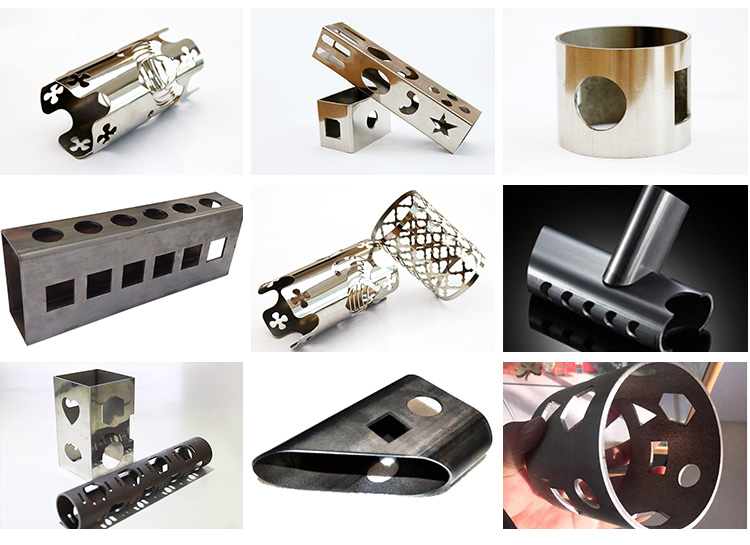
Advanced multi-axis cutting heads move in coordinated motion with the rotating chuck system, enabling complex three-dimensional cutting operations. The programmable, multi-axis cutting head can create intricate shapes and complex contours that are difficult to produce with conventional tools, including slots, miters, bevels up to 45 degrees, and elaborate decorative patterns.
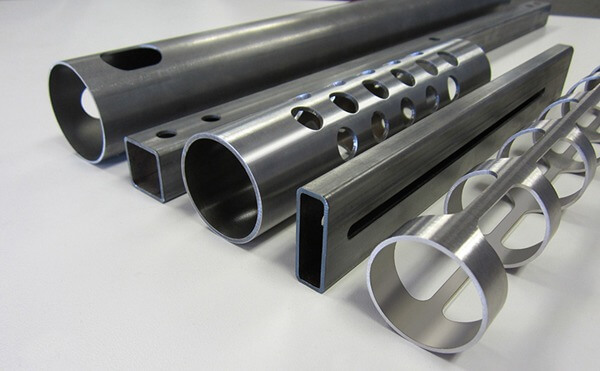
Metal tube laser cutting machines excel at processing diverse tube shapes and profiles. The machine is very suitable for cutting standard pipes such as round, square, rectangle, etc. It can also process most of the shaped pipes and open materials, such as hexagonal pipes, elliptical pipes, channels, angles, H-beams, etc. This versatility enables manufacturers to consolidate multiple specialized cutting operations into one system.
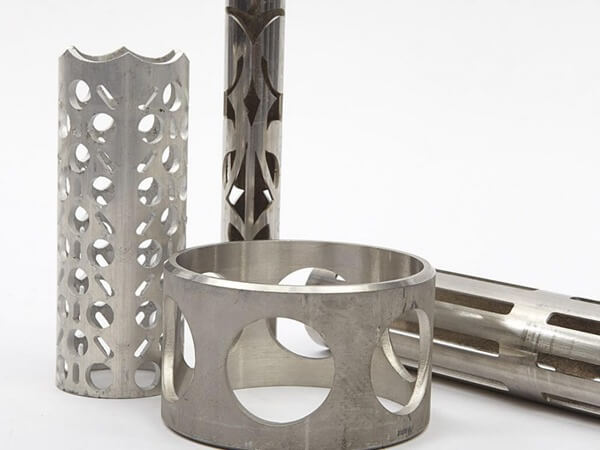
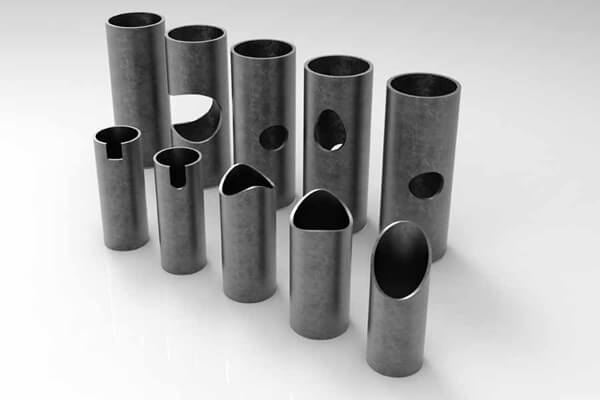
The technology supports an impressive range of operations beyond simple cutting. It can do hole cutting, beveling, grooving, vertical cutting, carving on metal tubes with high precision and efficiency. These capabilities prove essential for creating connection points, assembly features, and decorative elements directly on tubular components without secondary processing operations.
Industrial Applications: The versatility of tube laser cutting technology serves numerous industries with diverse requirements. In automotive manufacturing, these machines produce exhaust systems, chassis components, roll cages, and structural reinforcements with the precision necessary for modern vehicle assembly. Fitness equipment manufacturers rely on tube lasers for creating exercise machines, weight racks, and gym equipment featuring complex joints and connection points.
Construction and architectural metalwork applications include building frameworks, handrails, structural supports, and decorative metalwork. The furniture industry utilizes tube cutting for creating metal chair frames, table legs, shelving systems, and modern industrial-style furnishings. This metal tube laser cutter is widely used in automobile exhaust pipes, water pipes, oil pipes, fitness equipment, medical bed, bicycle frames, electric bicycle frames, baby carriages, kitchen storage racks, kitchenware, etc.
Agricultural machinery production benefits from tube laser capabilities for creating implement frames, spray booms, and structural components. Medical equipment manufacturers produce hospital beds, IV stands, surgical equipment frames, and rehabilitation devices. The aerospace sector employs tube cutting for aircraft interior structures, hydraulic line components, and lightweight structural elements where precision proves critical for safety and performance.
Modern tube laser cutting machines demonstrate exceptional material versatility, processing various metals with consistent quality. Tube laser cutters can handle a wide range of materials; mild steel, stainless steel, aluminum, brass, copper and more. Additional compatible materials include carbon steel, alloy steels, galvanized steel, titanium, and specialized alloys used in demanding applications.
The processing capacity of these machines varies by model but typically covers impressive dimensional ranges. The rotary device can hold up to a maximum of 220mm diameter metal tube, the standard tube length is 6 meters, and other lengths can be customized. Advanced industrial systems extend capabilities significantly, with tube and profile laser cutting systems capable of handling very heavy tubes, beams and profiles and tubes and profiles up to 24 inches in diameters and lengths up to 59 feet with automatic loading and unloading.
Wall thickness processing capabilities depend on laser power and material type. Higher-power systems ranging from 3000 to 6000 watts efficiently cut tubes with wall thicknesses from thin-gauge materials under 1 millimeter up to heavy-wall tubes exceeding 10 millimeters, depending on material composition and desired edge quality.
The benefits of laser tube cutting compared to conventional processing methods prove substantial across multiple performance dimensions. The fiber laser tube cutting machine uses high-density laser beams for cutting, achieving a cutting precision of 0.1mm, ensuring accurate and consistent dimensions of the cut parts. This exceptional accuracy enables tight-tolerance manufacturing previously requiring extensive secondary operations.
Processing speed represents another significant advantage. Its cutting speed is extremely fast, with straight-line cutting speeds exceeding 10,000 mm/min. These rapid processing rates dramatically reduce cycle times, enabling manufacturers to fulfill larger orders within shorter timeframes while maintaining consistent quality.
Edge quality produced by laser cutting eliminates or minimizes finishing requirements. Produce smooth, clean, burr-free edges with no post-processing required. The minimal heat-affected zone characteristic of laser cutting prevents thermal distortion, maintaining tube dimensional accuracy and material properties adjacent to cut areas.
Flexibility stands as a defining advantage of laser tube cutting technology. Compared to traditional cutting methods such as flame cutting, plasma cutting, and waterjet cutting, laser cutting offers higher precision, faster speeds, no need for molds, simple operation, and high automation, making it more flexible for processing applications. Design changes implement instantly through software updates rather than requiring expensive tooling modifications.
The contactless cutting process preserves material integrity. Laser cutting is a contactless process, preventing material contamination. This characteristic proves especially valuable when processing materials requiring pristine surfaces for subsequent coating, plating, or welding operations.
Understanding the critical components enables informed evaluation of tube laser cutting systems. The fiber laser source serves as the heart of the system, with manufacturers offering various power levels to match application requirements. Premium laser sources from established manufacturers like Raycus, Max, and IPG provide reliable performance, excellent beam quality with M-squared values approaching theoretical limits, and extended operational lifespans measured in tens of thousands of hours.
Chuck systems represent crucial components for workpiece handling. Adopting an advanced chuck clamping system, the chuck self-adjusts the center and automatically adjusts the clamping force according to the profile specifications to ensure that the thin tube is clamped without damage. Pneumatic and electric chuck options provide different advantages, with pneumatic systems offering rapid operation and electric chucks delivering precise position control.
Professional tube cutting software enables efficient programming and operation. It uses a professional pipe cutting system, which supports high-speed and high-efficiency cutting of various pipes and tubes. It has automatic pipe centering and eccentric compensation functions, ensuring the cutting accuracy. Advanced software packages include intelligent nesting algorithms that optimize material utilization, automatic collision detection preventing damage to cutting heads, and libraries of pre-programmed cutting strategies for common operations.
Automatic loading systems dramatically enhance productivity by eliminating manual material handling. Bundle loaders, part sorters, and CNC programming reduce manual handling and labor costs by automating material flow and production tasks. These systems prove especially valuable for high-volume production environments where continuous operation maximizes equipment utilization.
Support systems maintain tube stability during cutting operations. Adopting the intelligent pipe holder design, this machine solves the deformation problem in the process of long pipe cutting. Variable-diameter wheel supports and adjustable holding devices accommodate different tube dimensions while preventing sagging that would compromise cutting accuracy.

It belongs to a complete category of products, and its R&D team and production strength are very professional. At present, rectangular tube laser cutting machines are used [...]

A laser metal tube cutting machine is an automatic CNC pipe cutter that uses fiber laser beam to cut round tubes, square tubes, rectangular tubes, [...]

These machines are specifically designed to handle both round and square tubes, making them suitable for a wide range of applications. Whether you need to [...]

Laser-cutting technology has made significant advances in recent years, revolutionizing industries ranging from manufacturing and healthcare to aerospace and the arts. The precision, speed, and [...]
1 Comment

CNC laser cutting machines have revolutionized the field of precision metal tube fabrication. These machines offer high – accuracy cutting, enabling the production of complex [...]

A product in the pipe cutting market. The biggest feature of this product is that it can realize the “zero tailings” of pipe processing and [...]