iGWL-RW(C)
Laser Welding Machine Collaborative Robot
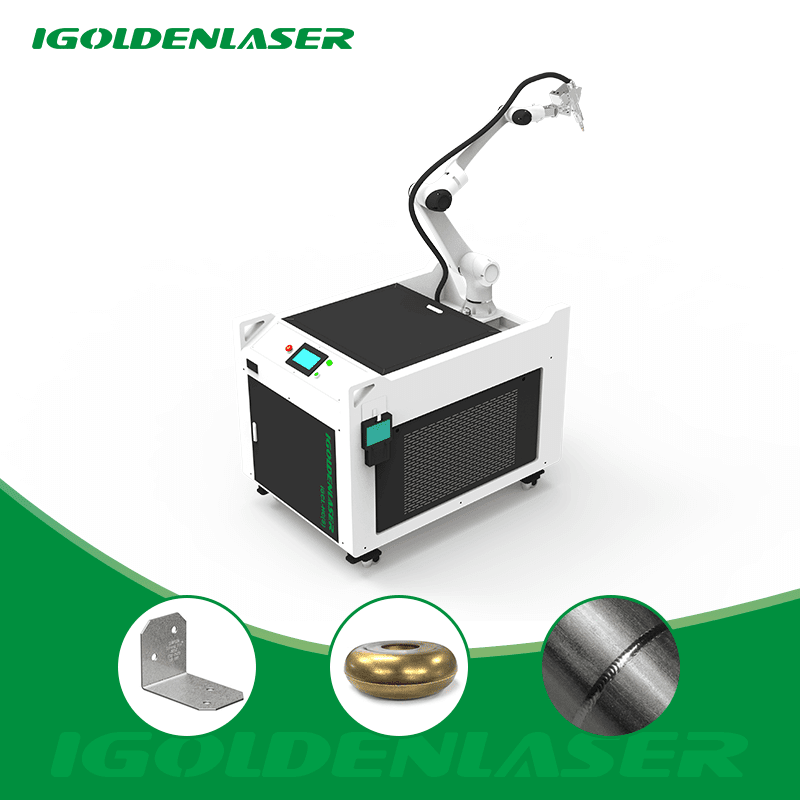
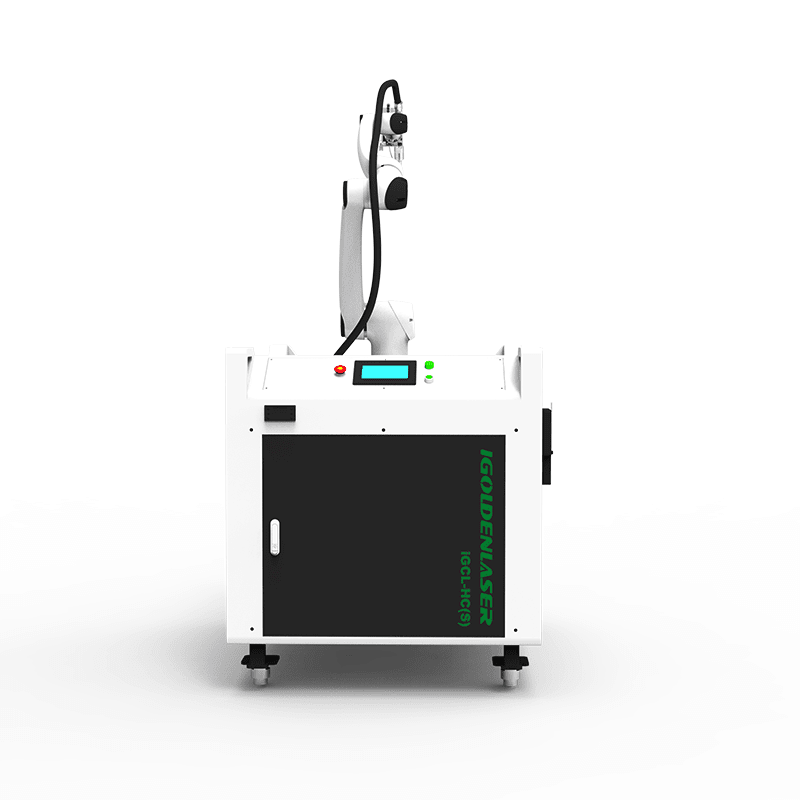
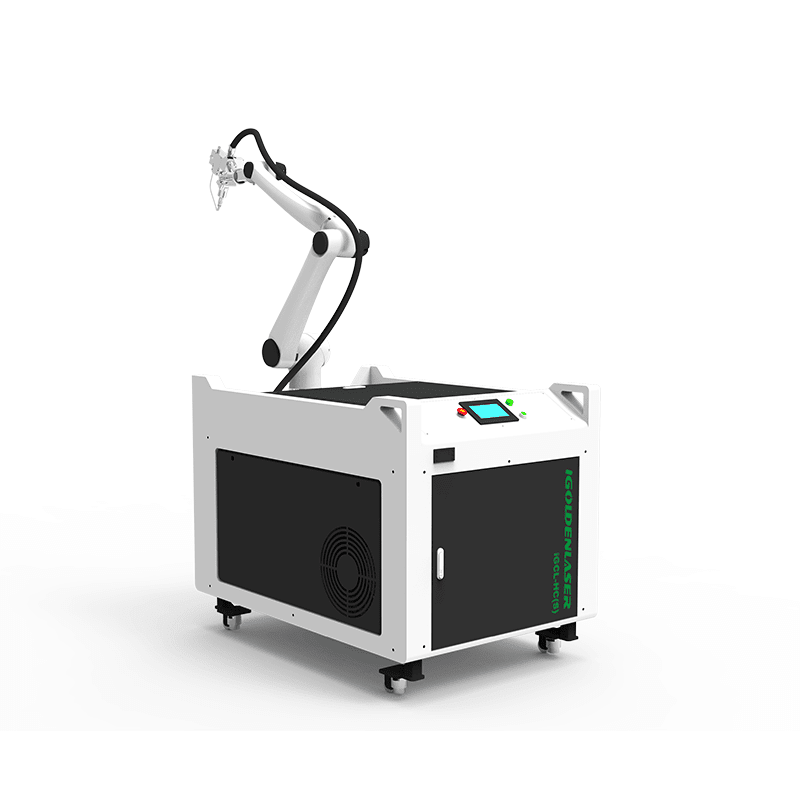
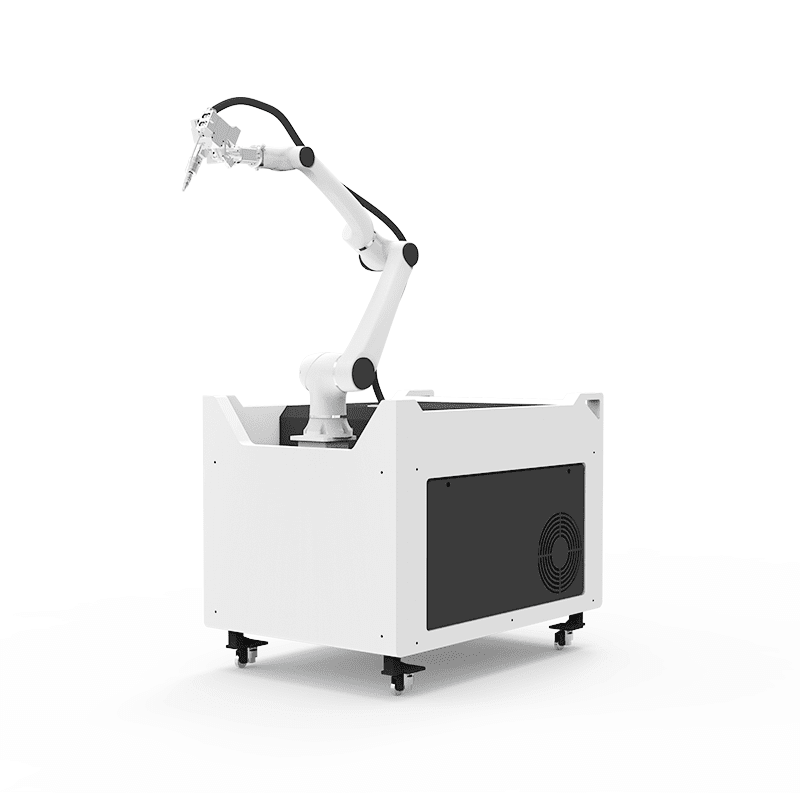
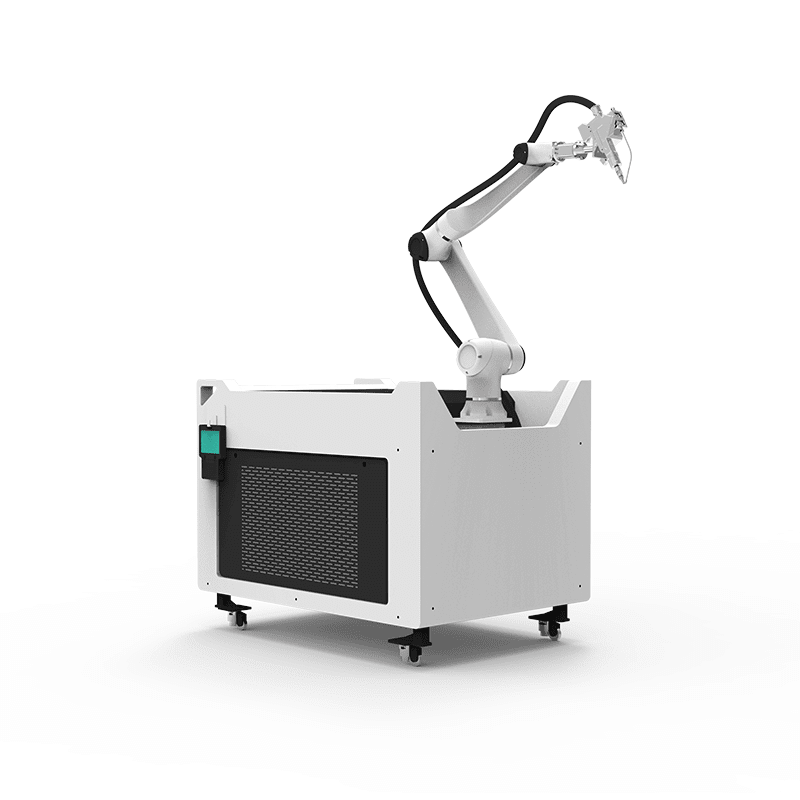
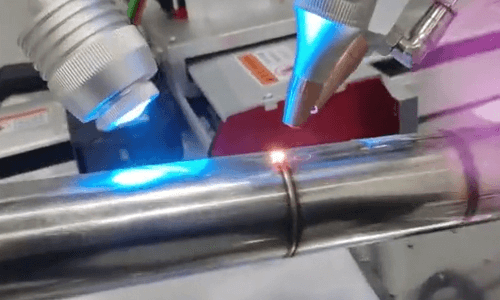
Automatic robotic laser welding machine consists of fiber laser, robot control system, positioning sensor, laser welding head and cooling system. It has the excellent welding speeds, aesthetic appearance and flexible movement of 6-axis robot arm.
The six axis configuration (rotation, lower arm, upper arm, wrist rotation, wrist swing, and wrist rotation) enables the end effector to orient the laser head in almost any direction — ideal for complex workpieces and 3D assemblies.
Collaborative robots can effectively cope with laser welding operations, helping to achieve flexible, efficient and free welding processes. Welding stability and consistency are higher, and product quality is easier to control.
- High precision: automatic fiber laser welding robot can achieve a high level of precision, resulting in accurate welds and a high-quality finished product.
- Flexibility for 3D weld paths and difficult-to-reach joints
- Faster welding speed: Since the laser beam is highly concentrated, it allows for faster and more efficient welding compared to traditional welding methods.
- Versatility & flexibility: Automatic robot laser welding machines are highly flexible and can handle a wide range of materials and thicknesses, including aluminum, stainless steel, and even plastics.
- Automated programming: Programming of the robotic laser welding machine can be automated, which means that it can be programmed to perform multiple welding tasks.
- Large work envelope: These machines have a large work envelope which allows them to handle large components and perform complex welding tasks.
Optional laser power 1500W-3000W; support customization.
6 Axis Robotic Laser Welding Machine Advantages
● This robotic laser welding system has low energy consumption, stable energy output, deep weld penetration, small heat-affected zone, small workpiece deformation, and fast welding speed.
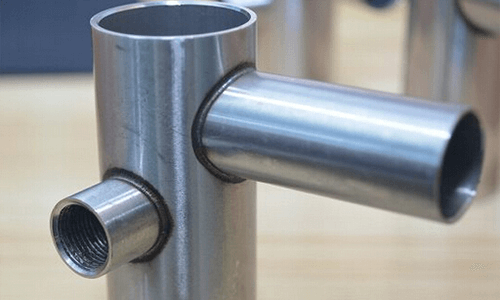
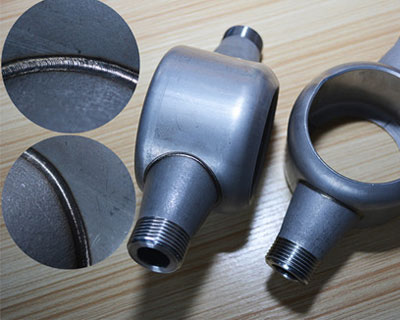
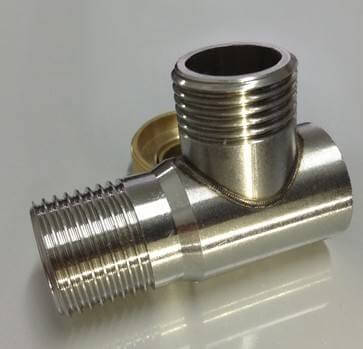
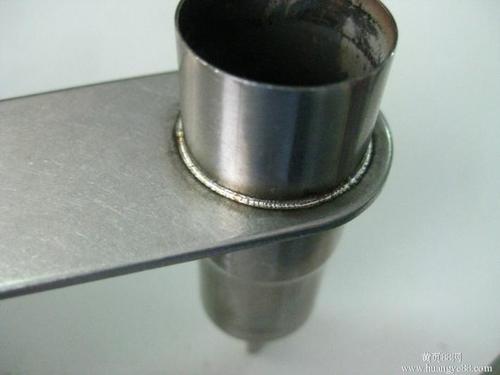
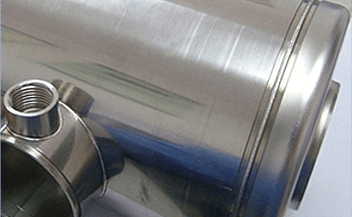
● The welding seam is smooth and beautiful, no need or simple treatment after welding.
● The fiber laser has no consumables, is convenient for daily maintenance, and has a service life of more than 100,000 hours.
● High electro-optical conversion rate, more energy-saving.
● Built-in cooling system, no need for external water supply cooling.
● The repetitive positioning accuracy of the robot can reach 0.01mm, and the performance is stable and reliable.
● The six-axis robot is more flexible and can perform welding operations in a larger space. It can realize flexible transmission and non-contact welding for precision parts.
TECHNICAL PARAMETER
| Model | iGWL-RW(C) | |
| System | iGOLDENLASER | |
| Power | 1500W-2000W | |
| Laser | MAX | |
| Laser welding system | Shunangshuai Laser(The system includes a welding head, a wire feeding mechanism, and a servo motor) | |
| Chiller | S&A | |
| Wire feeding machine | Push-pull wire feeding | |
| Robot parameters | ||
| Degree of freedom | SYNTEC Six-axis robot | |
| Drive mode | Servo drive | |
| Max. working radius | 1300mm | |
| Max. Load | 8KG | |
| Movement Range | Axis 1 | ±360° |
| Axis 2 | ±130° | |
| Axis 3 | +63°~ -243° | |
| Axis 4 | ±360° | |
| Axis 5 | ±180° | |
| Axis 6 | ±360° | |
| The joints are capable of a ±360° range of motion. However, due to application scenario limitations, the full range may not be achievable for each joint. Please note this during actual operation. | ||
| Movement Speed | Axis 1 | 100°/s |
| Axis 2 | 100°/s | |
| Axis 3 | 150°/s | |
| Axis 4 | 150°/s | |
| Axis 5 | 180°/s | |
| Axis 6 | 180°/s | |
| Work temperature | 0-45° | |
| Protection level | IP66 | |
| Machine size | 700*860*310mm | |
| Machine weight | 45KG | |
| Voltage | Single-phase 200-240V (50Hz-60Hz) | |
Welding head
The internal structure of the welding head is completely sealed to prevent the optical part from being polluted by dust.
The protective lens adopts a drawer structure, which is easy to replace.
Robot six-axis linkage
It combines the exactness of laser welding with the safety and flexibility of collaborative robots. The robot can handle tough jobs in places where humans and machines work side by side. This helps improve both the quality of the products and how fast they are made.
SYNTEC robot operation interface
Easy to operate, reliable in quality and long in life.
Fiber laser
We use advanced fiber lasers with a service life of more than 10w hours, low energy consumption, low failure rate, flexible fiber up to 10-15m, flexible and convenient, outdoor welding, equipped with a hard protective layer.
Laser Welder Applications
The fiber laser welding robot can work as efficiently as 3-4 conventional welding robots together, saving a lot of time on prototyping and investment in tooling, and reducing investment and costs.
It is used for precision metal welding processing, such as welding of hardware appliances, kitchen and bathroom industries and precision hardware welding of mobile phones, tablets, automobiles parts.
Applied Materials:
Mainly used for carbon steel, silicon steel, stainless steel, aluminum alloy, titanium alloy, galvanized steel sheet, pickling board, aluminum zinc plate, copper and many kinds of metal materials welding and so on. It can also be used for a variety of welding between different materials.
Cobot Laser Welding Machine Buyer Guide
A Laser Welding Cobot integrates a collaborative robot with a laser welding system.
Combining the high precision of laser welding with the flexibility of collaborative robots, it suits both small-batch, multi-variety welding and large-scale automated production.
Cobot laser welding (collaborative robot welding) integrates cobot welders with laser welding technology, enabling safe human-robot collaboration.
Compared to traditional industrial robot laser welding, its lighter design and easy operation are ideal for automotive, electronics, aerospace, and medical device welding, cutting rework costs, and boosting precision.
The working principle: A cobot welder guides the laser head precisely. The laser emits focused energy to melt materials at the weld point, while the cobot adjusts in real time—ensuring accurate, consistent fusion in laser welding processes.
Precision & Consistency in Laser Welding
Delivers uniform, high-accuracy welds with minimal material distortion, cutting rework caused by human error or fatigue.
Flexible Adaptation for Mixed Production
Quickly reprogrammed for different parts/shapes—no costly retooling, ideal for low-to-medium volume or mixed-model lines.
Cost-Effective Laser Welding Automation
Solves skilled welder shortages, operates 24/7, and lowers long-term costs via reduced downtime and waste.
User-Friendly Laser Welding Cobots
No robotics expertise needed—intuitive controls or hand-guided teaching let non-technical staff operate them easily.
Unmatched Precision: Robotic positioning accuracy within ±0.05mm combined with laser beam focus measured in tenths of millimeters creates welds of extraordinary precision. This accuracy enables joining thin materials, creating hermetic seals, and producing aesthetic welds meeting the strictest quality standards. Medical devices, aerospace components, and precision instruments demand this level of control.
Exceptional Speed: Laser welding operates at speeds dramatically exceeding TIG, MIG, or resistance welding. Travel speeds of 3-10 meters per minute are routine, with some applications achieving even higher rates. This speed advantage multiplies productivity while the robot’s continuous operation eliminates human fatigue limitations.
Superior Weld Quality: Concentrated laser energy creates deep penetration welds with narrow heat-affected zones. The result is strong metallurgical bonds with minimal thermal distortion, discoloration, or material property degradation. These characteristics are critical for structural integrity, corrosion resistance, and component aesthetics.
Minimal Distortion: Low heat input prevents warping and dimensional changes that plague conventional welding. Components maintain tight tolerances throughout welding, eliminating costly post-weld straightening or machining. This advantage particularly benefits thin-gauge materials and precision assemblies.
Dissimilar Material Joining: Laser welding successfully joins dissimilar metals that conventional methods struggle with—stainless to carbon steel, aluminum to copper, titanium to steel. The precise energy control prevents the metallurgical issues that compromise dissimilar material welds with traditional processes.
Reduced Consumables: Unlike MIG/MAG welding requiring wire, contact tips, and nozzles, or TIG using tungsten electrodes and filler rods, laser welding operates with minimal consumables. Protective lenses and assist gas represent primary ongoing costs, both modest compared to conventional welding consumables.
Clean Process: Laser welding generates minimal fumes, spatter, and waste compared to arc welding processes. This cleanliness improves workplace environments, simplifies quality control, and reduces post-weld cleaning requirements. Electronics manufacturing and medical device production particularly value this characteristic.
Laser welding machines are one of the most advanced welding technologies today. When it comes to welding, precision, and accuracy are of the essence. Unlike traditional welding techniques that use a flame or arc to melt and fuse metal, laser welding machines use a focused beam of light to achieve the same result. The laser welding process is very precise and is often used in applications where precision is critical, such as in the aerospace, automotive, and medical industries.
Laser welding machines are versatile and can weld a variety of metals, including steel, aluminum, copper, and titanium. It can weld dissimilar materials, making it an excellent choice for joining dissimilar metals. Additionally, laser welding offers a high degree of control over the welding process, allowing users to adjust welding parameters to suit their needs.
While a laser welding machine is more expensive to purchase than traditional welding methods, it offers high precision and consistency that can save money over time. This is especially true for high-volume manufacturing operations where efficiency is key.
Laser welding machines have gradually become an essential tool in industries that require precision and accuracy in welding tasks. Laser welding is a highly advanced and versatile welding technique that offers unparalleled precision, speed, and cleanliness. With its ability to weld a wide variety of materials and unmatched speed, it is a cost-effective solution for small to large industrial applications.
IGOLDENLASER offers manual and automatic laser welding machines for different work. In addition, the handheld laser welders have several models integrating laser welding, laser cleaning of rust and laser cutting functions. The laser welding technology of the automated laser welding machine is a very advanced technology that can weld a variety of materials, and it also has a variety of advantages that the traditional welding technology does not have, including no weld scars, beautiful welds, and workpieces. No deformation, etc. Therefore, it is widely used in more and more manufacturers.