
Laser Knowledge
What Is Laser Paint Removal?
What Is Laser Paint Removal?
Laser paint removal is a surface cleaning process that uses a focused laser beam to remove paint, coatings, oxides, rust, and other contaminants from a material without relying on traditional chemical strippers, abrasive blasting, or mechanical grinding.
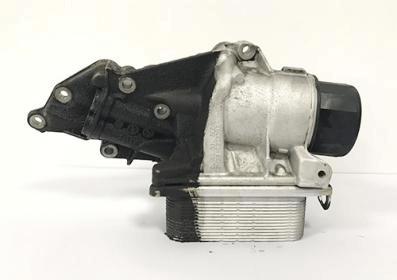
A laser paint removal machine directs high-energy laser pulses or a continuous laser beam onto the painted surface. The laser energy is absorbed by the coating, causing it to heat, break down, vaporize, or detach from the underlying material. The substrate can then be left exposed and ready for inspection, repainting, welding, coating, or other surface treatment.
Laser paint stripping is increasingly used in industrial manufacturing, automotive restoration, aerospace, shipbuilding, steel structures, machinery maintenance, and metal fabrication.
Compared with conventional paint removal methods, laser technology provides a more controlled and automated approach to removing coatings.
How Does Laser Paint Removal Work?
The basic principle of laser paint removal is based on the difference in how the paint and substrate absorb laser energy.
When the laser beam reaches a painted surface, the coating absorbs part of the laser energy.
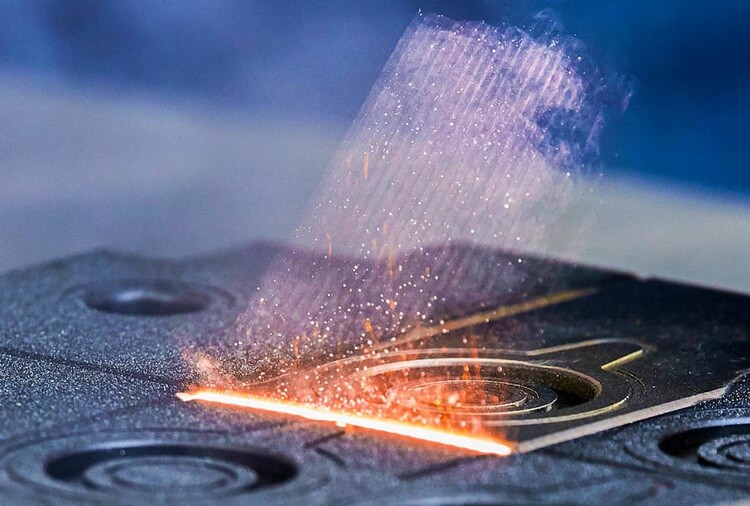
The resulting energy can cause:
Laser Energy → Rapid Heating → Coating Breakdown → Paint Separation or Removal
Depending on the laser type and operating parameters, the paint may:
- Vaporize
- Crack
- Burn off
- Thermally decompose
- Separate from the substrate
- Be lifted from the surface
The laser parameters can be adjusted according to the material and coating.
Important parameters include:
- Laser power
- Pulse duration
- Wavelength
- Frequency
- Scanning speed
- Scan width
- Focus position
- Number of passes
The goal is to remove the coating while minimizing unwanted effects on the underlying substrate.
What Can Laser Paint Removal Remove?
A suitable laser cleaning system can remove many types of coatings and contaminants.
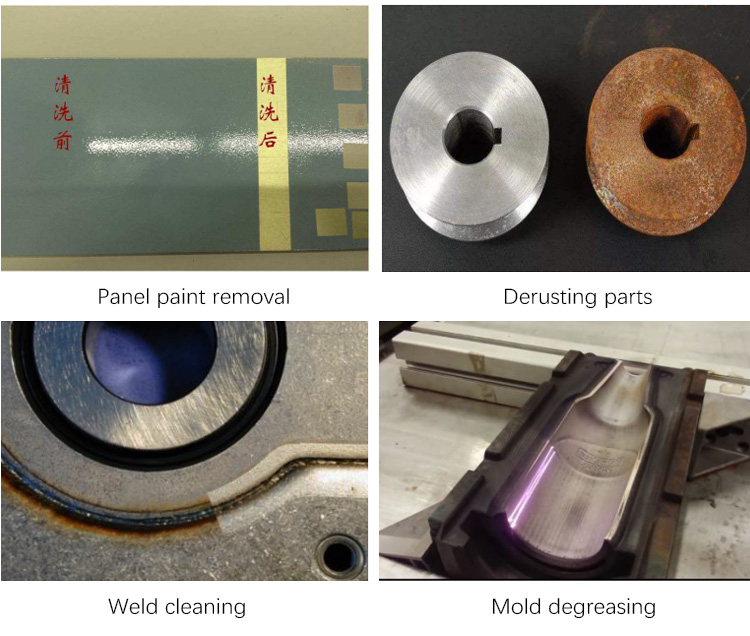
Common applications include:
Paint
Laser paint stripping can remove:
- Industrial paint
- Automotive paint
- Powder coating
- Protective coatings
- Decorative coatings
- Multi-layer paint
- Old paint
Rust and Oxides
Laser cleaning can also remove:
- Surface rust
- Oxide layers
- Corrosion products
- Heat discoloration
- Welding oxidation
Oil and Grease
Laser cleaning systems can remove certain:
- Oil residues
- Grease
- Dirt
- Manufacturing contaminants
Other Coatings
Depending on the material and machine configuration, laser cleaning can also be used for:
- Adhesive residues
- Rubber residues
- Carbon deposits
- Coating residues
- Surface contamination
What Is a Laser Paint Removal Machine?
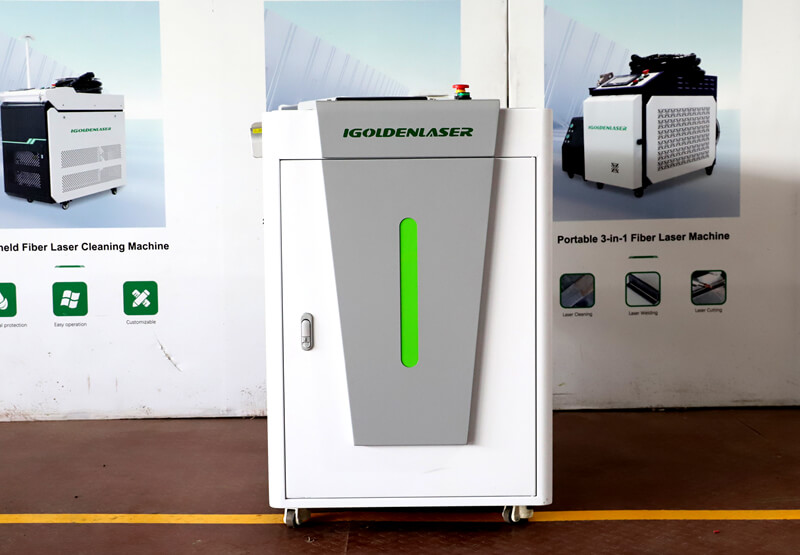
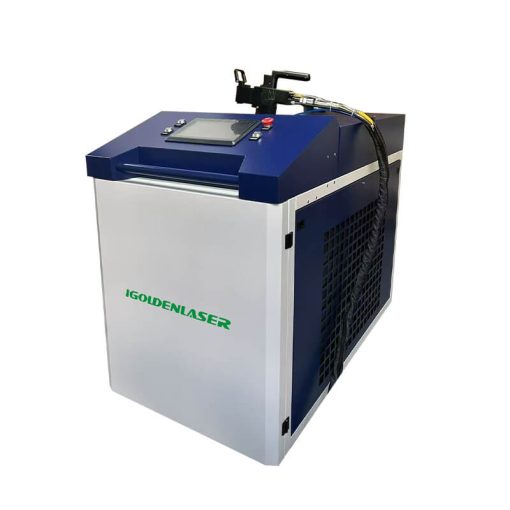
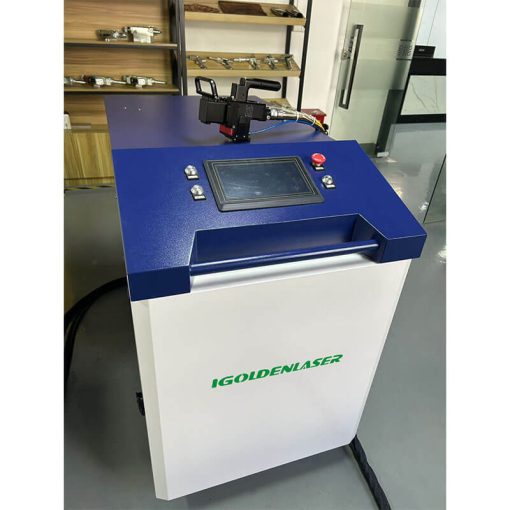
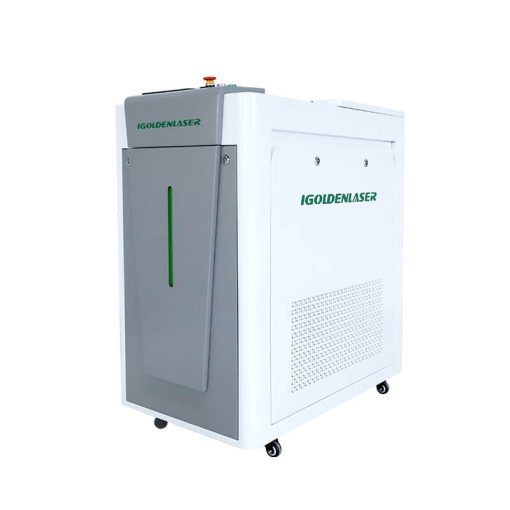
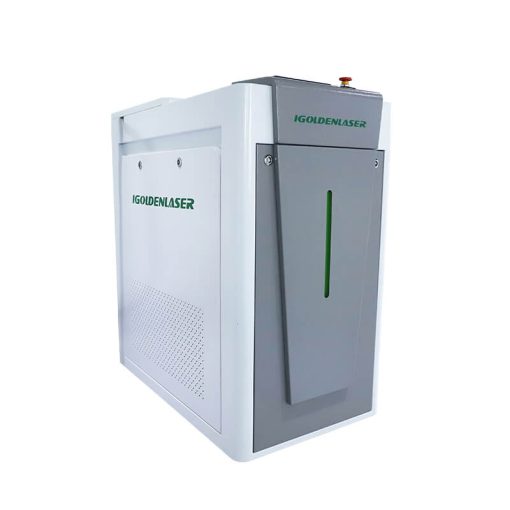
A laser paint removal machine is an industrial laser cleaning system specifically configured to remove paint and other coatings from surfaces.
A typical system includes:
- Fiber laser source
- Laser cleaning head
- Galvanometer scanning system
- Control system
- Cooling system
- Optical components
- Protective enclosure or safety equipment
- Fume and particle extraction where required
Some portable systems use a handheld laser cleaning gun, while automated systems can integrate laser cleaning into robotic or production-line applications.
Pulsed vs Continuous Wave Laser Paint Removal
One of the most important decisions when choosing a laser paint removal machine is selecting the appropriate laser type.
Pulsed Laser Paint Removal
Pulsed lasers deliver energy in short bursts.
They provide precise energy control and can be particularly useful when the coating needs to be removed while limiting heat input into the substrate.
Typical applications include:
- Precision paint removal
- Thin coatings
- Sensitive components
- Mold cleaning
- Electronics-related applications
- Detailed surface treatment
Pulsed laser cleaning is often preferred when thermal control and precision are more important than maximum large-area removal speed.
Continuous Wave Laser Paint Removal

Continuous-wave (CW) lasers deliver laser energy continuously rather than in individual short pulses.
High-power CW laser cleaning systems can be useful for:
- Heavy paint
- Thick coatings
- Large steel structures
- Large metal components
- Industrial equipment
- Shipbuilding
- Heavy machinery
- Large-area surface preparation

High-power CW systems can provide high productivity for applications where the substrate can tolerate greater thermal input.
How Powerful Does a Laser Need to Be for Paint Removal?
There is no single laser power that works best for every paint-removal application.
The appropriate power depends on:
- Paint thickness
- Paint composition
- Number of coating layers
- Substrate material
- Surface condition
- Required cleaning speed
- Required surface finish
- Thermal sensitivity
- Cleaning area
For example:
Lower-Power Systems
Can be suitable for:
- Light coatings
- Small components
- Precision cleaning
- Thin paint layers
Medium-Power Systems
Can be used for:
- General industrial paint removal
- Automotive components
- Machinery
- Metal parts
High-Power Systems
Such as 2000W, 3000W, and 6000w higher-power laser cleaning systems, can be suitable for demanding industrial applications involving large surfaces, heavier coatings, or higher production requirements.
Higher power does not automatically mean better results. The complete laser system and process parameters must be matched to the coating and substrate.
Laser Paint Removal on Metal
Metal is one of the most common substrates for laser paint stripping.
Laser systems can be used on materials such as:
- Carbon steel
- Stainless steel
- Aluminum
- Copper
- Cast iron
- Other metal components
Applications include:
Automotive Parts
Remove old coatings from:
- Vehicle components
- Engine parts
- Frames
- Wheels
- Metal assemblies
Industrial Machinery
Remove:
- Old paint
- Coatings
- Oil contamination
- Oxidation
Steel Structures
Laser cleaning can be used for surface preparation before:
- Repainting
- Welding
- Inspection
- Coating
Advantages of Laser Paint Removal
1. Non-Contact Cleaning
The laser beam removes contaminants without requiring physical contact between a cleaning tool and the surface.
2. Precise Processing
Laser parameters can be adjusted to control the cleaning process.
3. No Abrasive Media
Unlike sandblasting, laser cleaning does not require a continuous supply of abrasive blasting media.
4. Reduced Consumables
The process does not require conventional chemical paint strippers or abrasive media.
5. Automation
Laser cleaning systems can be integrated with:
- CNC systems
- Robotic arms
- Automated production lines
- Machine vision
- Programmable scanning systems
6. Flexible Applications
The same machine can potentially be used for:
- Paint removal
- Rust removal
- Oxide removal
- Degreasing
- Surface preparation
The exact capabilities depend on the laser source and system configuration.
Laser Paint Removal vs Traditional Paint Stripping
Traditional paint removal methods include chemical stripping, sandblasting, dry ice blasting, wire brushing, grinding, and other mechanical processes.
Laser paint removal offers a different approach.
| Feature | Laser Paint Removal | Chemical Stripping | Sandblasting | Mechanical Grinding |
|---|---|---|---|---|
| Chemicals required | No | Yes | No | No |
| Abrasive media | No | No | Yes | No |
| Contact with surface | Non-contact | Contact/chemical | Abrasive | Contact |
| Surface control | High | Medium | Medium | Medium |
| Consumable media | Minimal | Chemicals | Abrasive media | Abrasives |
| Automation potential | High | Medium | High | Medium |
| Suitable for precision work | Excellent | Limited | Limited | Medium |
| Secondary waste | Relatively low | Chemical waste | Abrasive waste | Dust/debris |
The actual environmental impact, waste generation, and operating cost depend on the specific process, coating, substrate, extraction system, and production environment.
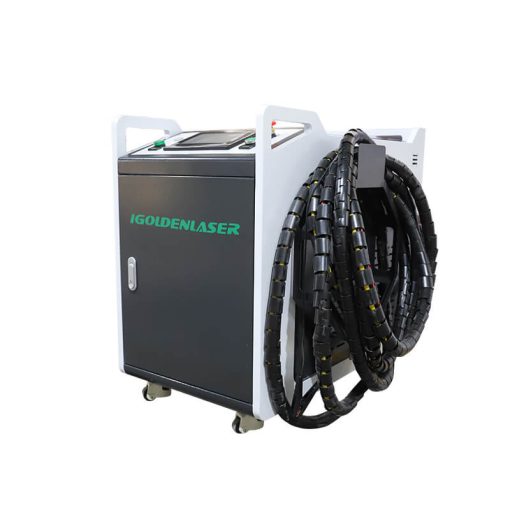
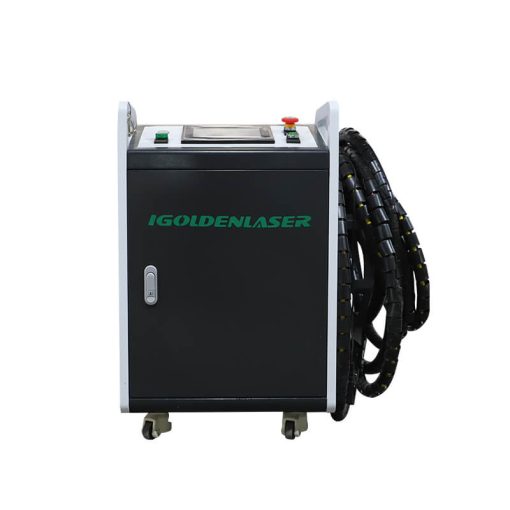
Laser Cleaning Machine


Laser Cleaning Machine
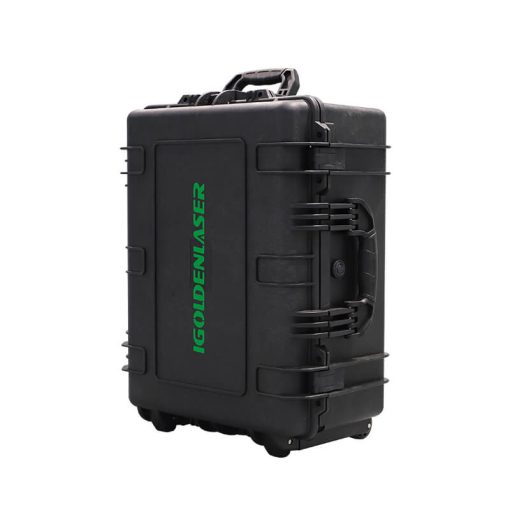
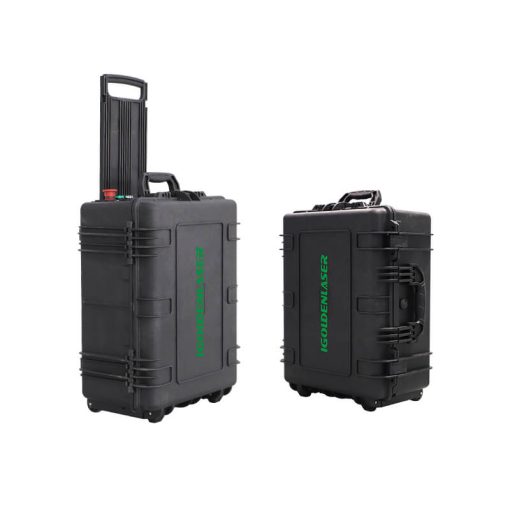
Laser Cleaning Machine
Laser Cleaning Machine
Laser Cleaning Machine


Laser Cleaning Machine
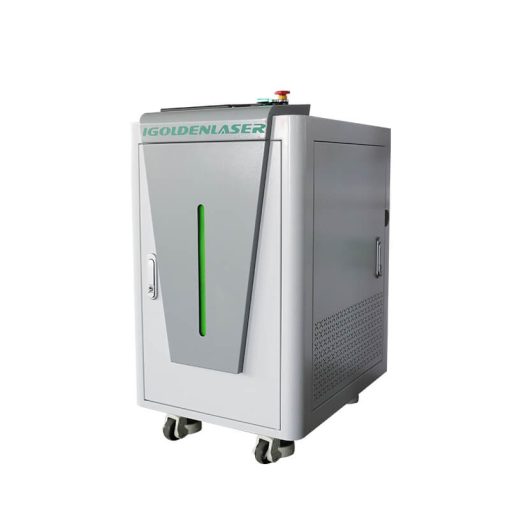
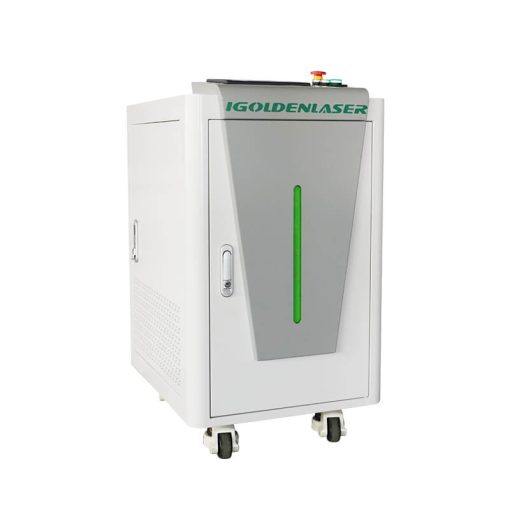
Laser Cleaning Machine
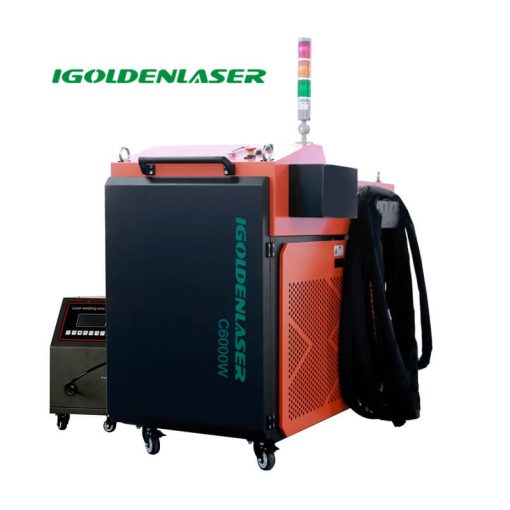
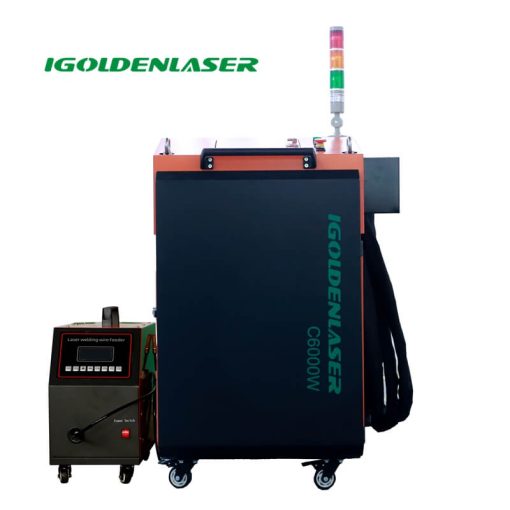
Laser Cleaning Machine
How to Choose a Laser Paint Removal Machine
When purchasing a laser paint removal machine, do not evaluate the equipment based only on laser power.
Consider the following factors.
Laser Type
Determine whether pulsed or continuous-wave laser technology is more appropriate for your application.
Laser Power
Choose power according to coating thickness, surface area, material, and required productivity.
Cleaning Width
A wider scan width can increase productivity for large surfaces, while a narrower beam can provide greater control for detailed work.
Laser Source
The quality and reliability of the laser source can influence machine stability and operating life.
Cooling System
Higher-power laser systems require an appropriate cooling solution.
Cleaning Head
The scanning head should provide the required scanning range and control.
Fume Extraction
Paint removal can generate fumes and particles. Make sure the workplace has an appropriate extraction solution.
Portability
For field maintenance, a portable handheld system may be preferred.
For factory production, a fixed or automated system may be more suitable.
iGOLDENLASER Laser Paint Removal Machine
iGOLDENLASER provides industrial laser cleaning solutions for applications including paint removal, rust removal, oxide removal, surface preparation, and coating cleaning.
The iGOLDENLASER Laser Paint Removal Machine can be configured according to different industrial cleaning requirements.
Potential applications include:
- Paint stripping
- Rust removal
- Metal surface cleaning
- Coating removal
- Welding preparation
- Machinery maintenance
- Industrial refurbishment
For demanding applications, higher-power configurations such as 3000W laser cleaning machines can be considered where high productivity and large-area coating removal are required.
For more precision-oriented applications, pulsed laser cleaning configurations may be more appropriate.
The best configuration should be selected according to the coating, substrate, cleaning area, required productivity, and surface quality requirements.

IGOLDEN BLOG
Thank you for visiting the iGOLDENCNC website. iGOLDENCNC is the professional supplier of CNC machinery application solution, within the business of producing and selling CNC machinery and accessories.