iGWL-RW series
Robot Laser Welding Machine
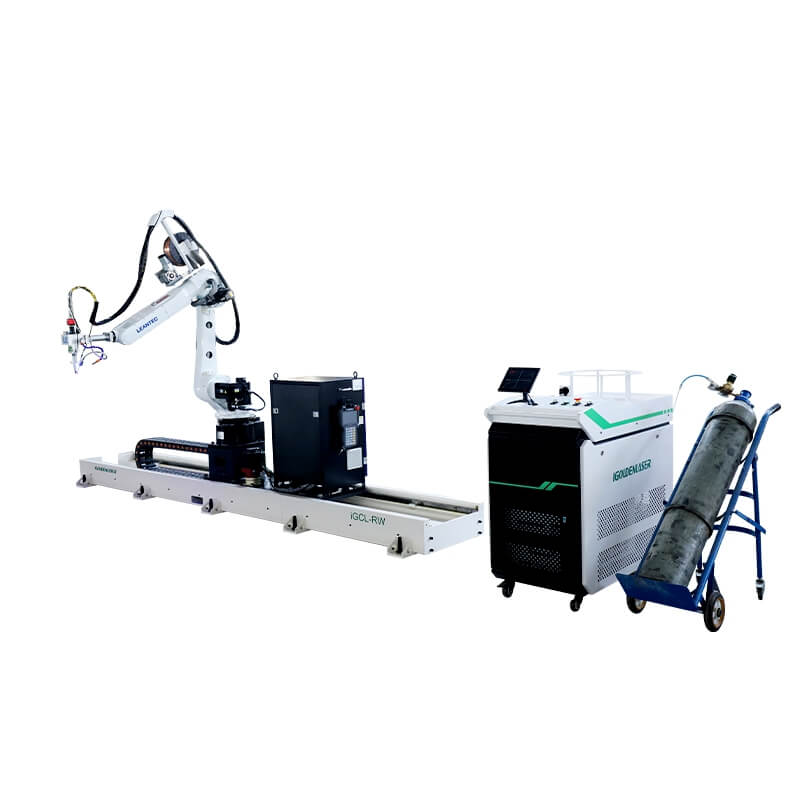
A ground rail fiber laser welding robot is an automated welding system that combines a fiber laser welding head with a robotic arm or CNC-controlled torch carriage mounted on a linear ground rail — a precision track installed on or flush with the workshop floor that guides the welding system along its working length. The ground rail provides the extended linear travel axis that enables the welding system to follow long weld joints, traverse large workpieces, and reach positions across wide assembly fixtures that a fixed robotic arm on a stationary pedestal cannot access.
The IGOLDENLaser Ground Rail Fiber Laser Welding Robot integrates three core technologies into a single automated welding platform. The fiber laser source — ranging from 1,500W to 6,000W depending on configuration — generates the precision laser beam that delivers welding energy to the joint with the beam quality, controllability, and thermal management that fiber laser technology uniquely provides. The robotic arm or CNC torch carriage positions the laser welding head at the correct working distance, angle, and orientation relative to the joint throughout every weld pass — executing programmed weld paths with the positional accuracy and travel speed consistency that manual operation cannot sustain. The ground rail linear axis extends the system’s working envelope along the rail direction — enabling continuous welding along joints of any length, sequential welding at multiple stations along a production line, or repositioning between different weld locations on large-format workpieces.
The combination creates a welding capability that scales to the workpiece rather than being limited by the robot’s fixed reach — the ground rail effectively extends the robot’s working envelope to the full length of the installed rail, which can range from 3 meters for small production cells to 30 meters or more for shipbuilding, structural steel, and large-format industrial fabrication.
Optional laser power 1500W-6000W; support customization.
Robot Laser Welding Advantages
- Process Monitoring and Control: Robotic fiber laser welding machines often incorporate advanced monitoring and control systems to ensure welding quality and process stability. These systems can monitor parameters such as laser power, welding speed, and weld quality in real-time. They may also include features like adaptive control to compensate for variations in material thickness or fit-up.
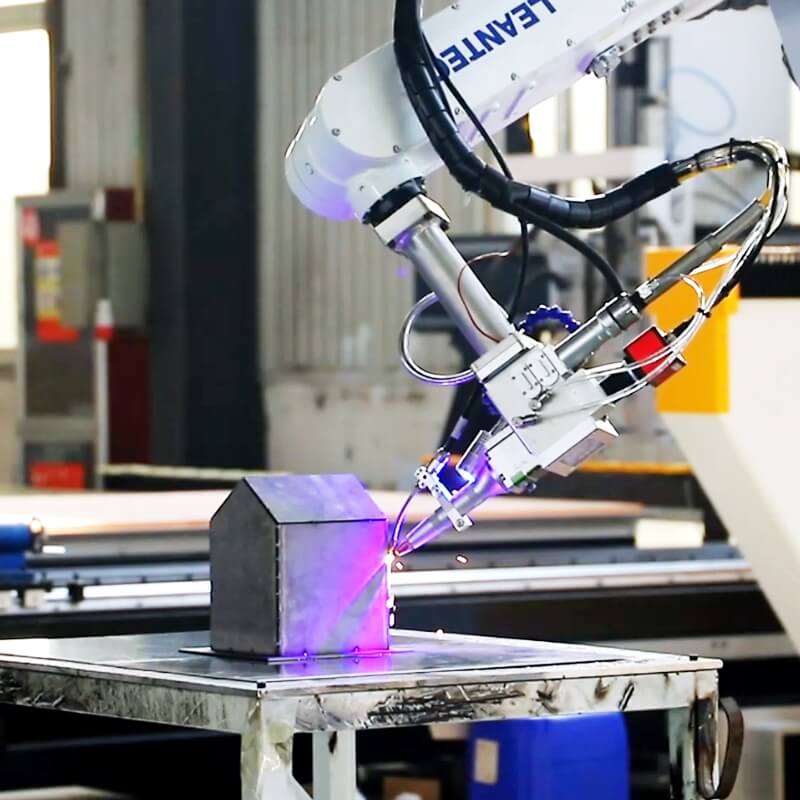
- Robotic System Integration: A robotic fiber laser welding machine integrates a robotic arm to manipulate the welding process. The robot arm(s) is programmed to position the workpiece and control the laser beam accurately, ensuring precise and consistent welding. This integration enables automation, flexibility, and the ability to weld complex geometries.
- Fiber Laser Technology: Fiber lasers use optical fibers to deliver the laser beam to the welding head. They are known for their high power density, excellent beam quality, and energy efficiency. Fiber lasers emit a concentrated laser beam that can be precisely controlled, providing high-quality and efficient welding results.
- Flexibility and Versatility: The robotic system in a fiber laser welding machine offers flexibility in positioning and manipulating the workpiece and laser beam. This allows for welding in various orientations, angles, and hard-to-reach areas. The machine can be programmed to perform different welding paths, joint configurations, and welding sequences, making it adaptable to a variety of welding applications.
TECHNICAL PARAMETER
| Model | iGWL-RW- 1500 | iGWL-RW- 2000 | iGWL-RW- 3000 |
| Laser power | 1500W | 2000W | 3000W |
| Laser wavelength | 1080±10nm | ||
| Robot | SYNTEC welding robot | ||
| Max. load on the wrist | 20KG | ||
| Repeatability | ±0.08mm | ||
| Range of motion | J1 | ±170° | |
| J2 | 135/-90° | ||
| J3 | 75/-140° | ||
| J4 | ±170° | ||
| J5 | ±130° | ||
| J6 | ±360° | ||
| Max. speed | J1 | 190º/s | |
| J2 | 140º/s | ||
| J3 | 140º/s | ||
| J4 | 320º/s | ||
| J5 | 150º/s | ||
| J6 | 320º/s | ||
| Welding material thickness | ≤4mm | ≤6mm | ≤8mm |
| Welding gap requirements | ≤0.3mm | ||
| Operating Voltage | 220V±10%/380V±10% | ||
| Total power | ≤8kw | ≤10kw | ≤12kw |
| Machine gross weight | 268KG (robot) + 260KG (cleaning machine) | ||
| Remarks: Can be customized according to customer requirements (other brands of robots can be customized) | |||
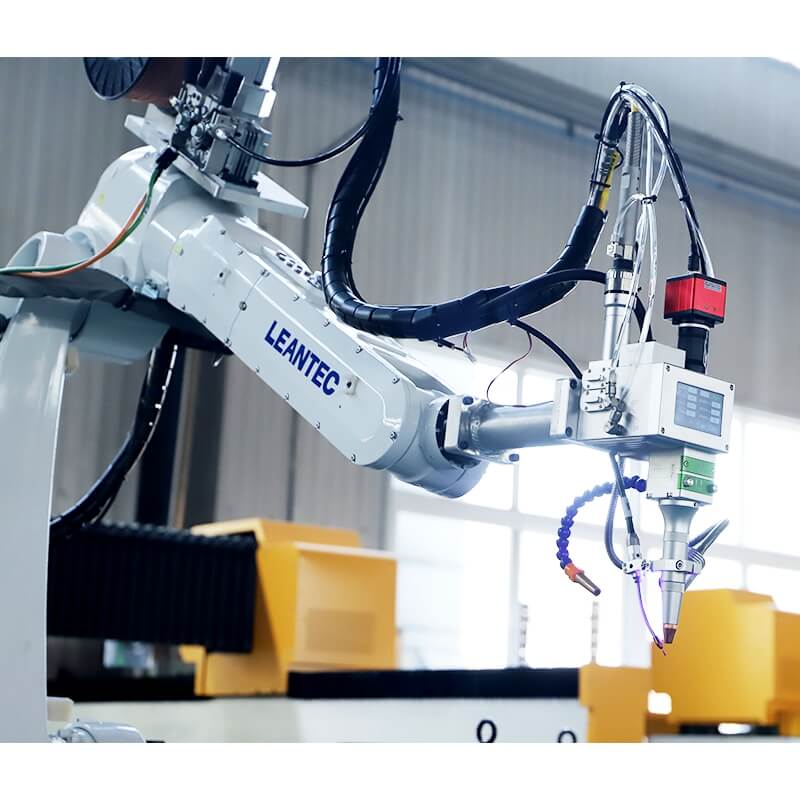
Welding head
The internal structure of the welding head is completely sealed to prevent the optical part from being polluted by dust.
The protective lens adopts a drawer structure, which is easy to replace.
Robot six-axis linkage
The six-axis linkage of the robot can easily realize the welding of three-dimensional workpieces.
Cooperating with special tooling and linkage workbench, it can realize fully automatic welding in one clamping.
SYNTEC robot operation interface
Easy to operate, reliable in quality and long in life.
Fiber laser
We use advanced fiber lasers with a service life of more than 10w hours, low energy consumption, low failure rate, flexible fiber up to 10-15m, flexible and convenient, outdoor welding, equipped with a hard protective layer.
Handheld Laser Cleaning Machine for Removing Rust, Stains, Paint
Applicable materials: stainless steel, carbon steel, galvanized sheet, aluminum alloy, copper, etc.;
Applicable industries: Widely used in auto parts, stainless steel kitchen utensils, sheet metal processing, electronic chassis, door and window guardrails, steel structure industry, animal husbandry industry, furniture industry, hardware industry and many other new energy industries.
FAQ
A standard welding robot is a fixed-pedestal 6-axis robotic arm whose working envelope is limited to the reach of the arm from its stationary base — typically a sphere of 1.5–2.5 meters radius. A ground rail fiber laser welding robot mounts the same robotic arm on a servo-driven carriage that travels along a linear ground rail track — extending the system’s working envelope along the rail to any length the rail provides. This rail travel axis enables the system to weld joints longer than the robot’s fixed reach, to service multiple welding fixtures along the production line from a single robot, and to reposition between joint locations on large assemblies without manual fixture repositioning. The fiber laser welding process — versus the MIG or TIG torch on a conventional welding robot — adds the beam quality, penetration depth, travel speed, and minimal heat input advantages of laser welding to the automated motion capability of the ground rail system.
The IGOLDENLaser ground rail fiber laser welding system welds all common structural and engineering metals: mild steel, high-strength low-alloy structural steel, stainless steel (all grades), aluminum alloys (5xxx and 6xxx series most commonly), galvanized steel, copper, titanium, and nickel alloys. Dissimilar metal combinations — stainless steel to carbon steel, aluminum to copper — can be joined with appropriate filler wire selection and parameter optimization. Each material requires specific laser power, travel speed, beam oscillation, and shielding gas parameters — validated through weld procedure qualification before production welding begins.
Understanding the major components of the IGOLDENLaser Ground Rail Fiber Laser Welding Robot helps you evaluate build quality and identify the elements most critical to long-term welding performance and system reliability.
High-Power Fiber Laser Source
The IGOLDENLaser fiber laser source is the heart of the system — generating the beam with the power, beam quality, and controllability that automated precision laser welding demands. Available in continuous wave (CW) configurations from 1,500W to 6,000W, the IGOLDENLaser fiber laser source delivers rated output power continuously throughout extended automated welding cycles — not just during brief manual welding intervals. The CW architecture maintains consistent power delivery throughout long production runs, providing the stable, predictable energy input that automated process control depends on. Beam quality M² < 1.1 ensures the beam focuses to the tight spot size that deep-penetration keyhole welding on structural joints requires. The sealed fiber laser module design — no user-serviceable internal optics — eliminates the optical alignment maintenance that older laser technologies require and provides the >100,000-hour pump diode service life that automated production environments demand.
Industrial Robotic Arm
The IGOLDENLaser system uses a 6-axis industrial robotic arm — from leading robotics manufacturers including FANUC, KUKA, ABB, and Yaskawa — as the primary motion system for torch positioning. The 6-axis arm provides the full spatial freedom required to position the laser welding head at any angle relative to any joint geometry — vertical, horizontal, overhead, and all positions between. Payload capacity is matched to the combined weight of the laser welding head, seam tracker, wire feeder, and associated hardware — typically 10–20 kg of torch assembly weight — with adequate margin to maintain positional accuracy under the dynamic loads of synchronized rail travel and weld path following. Robot reach — the maximum distance from the robot base to the TCP (tool center point) — is selected to cover the full working width of the welding fixture with comfortable margin.
Ground Rail Linear Axis
The ground rail is the defining structural component of the system — the precision linear track that extends the robot’s working envelope along the production line length. IGOLDENLaser ground rails use precision machined steel rail sections mounted on a leveled steel base structure, with rack-and-pinion or linear servo drive systems providing smooth, accurate travel at the speeds required for synchronized rail-and-robot motion during long-seam welding. Rail straightness — the critical geometric specification for weld path accuracy during rail-travel welding — is specified at ±0.1mm per meter and verified by laser interferometer measurement before system acceptance. Rail length is configurable from 3 meters for compact production cells to 30 meters and beyond for large-format structural and marine welding applications. The robot base carriage travels along the rail on precision linear bearings, driven by the rail axis servo with encoder feedback that integrates rail position into the robot controller’s coordinate system as a synchronized external axis.
Laser Welding Head with Oscillation
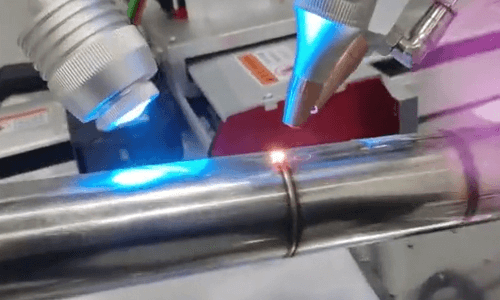
The IGOLDENLaser welding head delivers the fiber-transmitted laser beam to the workpiece surface through a collimating and focusing optic system, producing the focal spot geometry required for the specific weld joint and material thickness. An integrated galvanometer beam oscillation system sweeps the focal spot in a programmable pattern — circular, figure-8, or linear — perpendicular to the travel direction, widening the effective weld pool without sacrificing penetration depth. Oscillation frequency (10–200 Hz) and amplitude (0.5–5mm) are programmable from the system controller and stored in joint-specific weld parameter files. The welding head includes a protective window — a consumable optical element shielding the focusing lens from weld spatter and fume — a shielding gas nozzle with programmable flow control, and mounting provisions for the seam tracking sensor and wire feeder nozzle.
Laser Seam Tracking System
The seam tracking system is the sensor intelligence that makes automated laser welding reliable on real production parts with dimensional variation. A structured laser line projected across the joint ahead of the welding torch creates a reflected pattern whose deformation reveals the joint’s actual position, gap width, and surface geometry. A high-speed camera captures this pattern at rates of 100–1,000 frames per second, and the tracking software computes real-time corrections to the robot’s TCP position — keeping the laser focal spot precisely on the joint regardless of part-to-part variation. Without seam tracking, automated laser welding requires part positioning tolerances tighter than most production fixtures can consistently achieve — with seam tracking, the system compensates for realistic production variation and delivers consistent weld placement on every part.
Wire Feeder System
For weld joints requiring filler metal addition — gap bridging on butt joints, fillet weld reinforcement, and dissimilar metal joining — the IGOLDENLaser system includes a motorized wire feeder with programmable feed speed synchronized to weld travel speed and laser power. Wire diameters from 0.8mm to 1.6mm are accommodated in a push-pull feeding system that maintains consistent wire delivery speed independent of torch orientation — critical on vertical and overhead joint positions where gravity-driven wire feeding inconsistency would affect weld quality. Wire feed speed, wire stick-out length, and wire position relative to the laser focal spot are all programmable parameters stored in the joint-specific weld procedure file.
System Controller & Offline Programming Interface
The IGOLDENLaser system controller integrates robot motion control, ground rail axis control, laser power management, beam oscillation control, seam tracking, wire feed, and shielding gas delivery into a single coordinated control architecture. The offline programming interface allows weld programs to be developed from CAD models of the workpiece — generating robot joint trajectories, rail axis positions, and weld parameter assignments — without requiring the physical system to be offline for programming. The controller’s process monitoring system records laser power, travel speed, seam tracker corrections, and wire feed data for every weld — providing traceability records that quality-critical industries including pressure vessel fabrication, structural steel, and automotive increasingly require.
Laser welding machines are one of the most advanced welding technologies today. When it comes to welding, precision, and accuracy are of the essence. Unlike traditional welding techniques that use a flame or arc to melt and fuse metal, laser welding machines use a focused beam of light to achieve the same result. The laser welding process is very precise and is often used in applications where precision is critical, such as in the aerospace, automotive, and medical industries.
Laser welding machines are versatile and can weld a variety of metals, including steel, aluminum, copper, and titanium. It can weld dissimilar materials, making it an excellent choice for joining dissimilar metals. Additionally, laser welding offers a high degree of control over the welding process, allowing users to adjust welding parameters to suit their needs.
While a laser welding machine is more expensive to purchase than traditional welding methods, it offers high precision and consistency that can save money over time. This is especially true for high-volume manufacturing operations where efficiency is key.
Laser welding machines have gradually become an essential tool in industries that require precision and accuracy in welding tasks. Laser welding is a highly advanced and versatile welding technique that offers unparalleled precision, speed, and cleanliness. With its ability to weld a wide variety of materials and unmatched speed, it is a cost-effective solution for small to large industrial applications.
Product configuration
| Category | Name | Manufacturer/Brand |
| 1 | Laser | MAX |
| 2 | Welding head | Ruifa/Hanwei |
| 3 | Pneumatic Components | Japan SMC |
| 4 | Relay/air switch | French Schneider/Chint |
| 5 | Control System | SYNTEC robot system + iGOLDENLASER welding system |
| 6 | chiller | Hanli/S&A |
| 7 | Cable | Standard 10 meters |
IGOLDENLASER offers manual and automatic laser welding machines for different work. In addition, the handheld laser welders have several models integrating laser welding, laser cleaning of rust and laser cutting functions. The laser welding technology of the automated laser welding machine is a very advanced technology that can weld a variety of materials, and it also has a variety of advantages that the traditional welding technology does not have, including no weld scars, beautiful welds, and workpieces. No deformation, etc. Therefore, it is widely used in more and more manufacturers.