
Buyer Guide
What is a CNC Oscillating Knife Cutting Machine?
CNC Oscillating Knife Cutting Machines utilize high-speed oscillating knifes to replace traditional cutting tools or laser methods, achieving high-precision cutting of materials such as leather, fabric, foam, and rubber. They are widely used in industries including apparel, packaging, automotive interiors, advertising, and luggage manufacturing.
This article comprehensively analyzes the characteristics and key selection points of this equipment—from working principles, machine types, blade configurations, and application fields to maintenance—helping businesses and individuals make smarter decisions during selection and operation.
What is a CNC Oscillating Knife Cutting Machine?
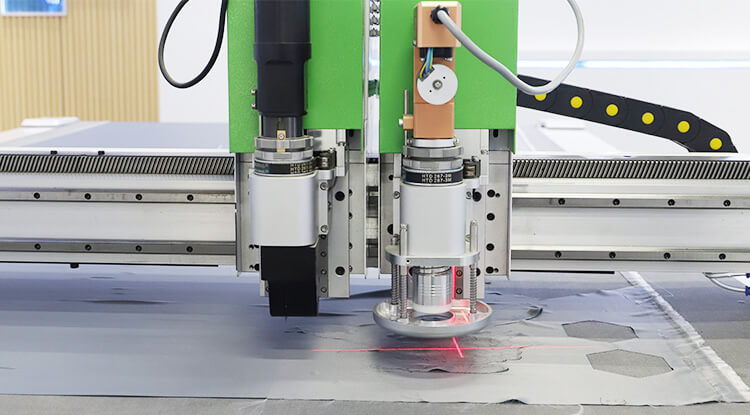
Basic Definition of CNC Oscillating Knife Cutting Machines
A CNC Oscillating Knife cutter is an automated device that employs computer numerical control (CNC) to regulate high-frequency vertical blade oscillations, enabling precise material cutting. Unlike traditional mechanical cutting, it requires no molds and swiftly adapts to small-batch, diverse production demands.
The Oscillating Knife typically oscillates thousands of times per minute, achieving clean, precise cuts. It is particularly suited for soft or composite materials such as leather, fabric, foam, rubber sheets, and cardboard.
Differences from Traditional Cutting Methods
Compared to laser cutting, Oscillating Knife cutting avoids scorched edges or charring, preserving the material’s original texture and color. Unlike mechanical die-cutting, it operates without fixed molds, reducing mold costs and enhancing flexibility.
Additionally, CNC systems enable path optimization and automatic nesting, significantly reducing material waste and boosting overall production efficiency.
How does a CNC Oscillating Knife cutter work?
CNC Oscillating Knife cutters operate through the coordinated work of a CNC system, servo drive system, and Oscillating Knife head module.
- Program Control: The operator imports cutting drawings into the software, and the system converts the graphics into path commands.
- Motion Execution: Servo motors drive the blade head along the programmed trajectory while the blade vibrates vertically at high frequency to achieve precise cutting.
- Adhesion and Fixation: The worktable typically employs a vacuum adhesion system to securely hold the material in place, preventing slippage.
- Cutting: Vibration frequency and feed rate are adjusted based on material thickness and hardness to ensure clean, smooth cuts.
The entire process is fully automated without manual intervention, achieving cutting precision of ±0.1mm.
For different materials, parameters can be quickly adjusted via software or by replacing tool modules, significantly enhancing the machine’s versatility.
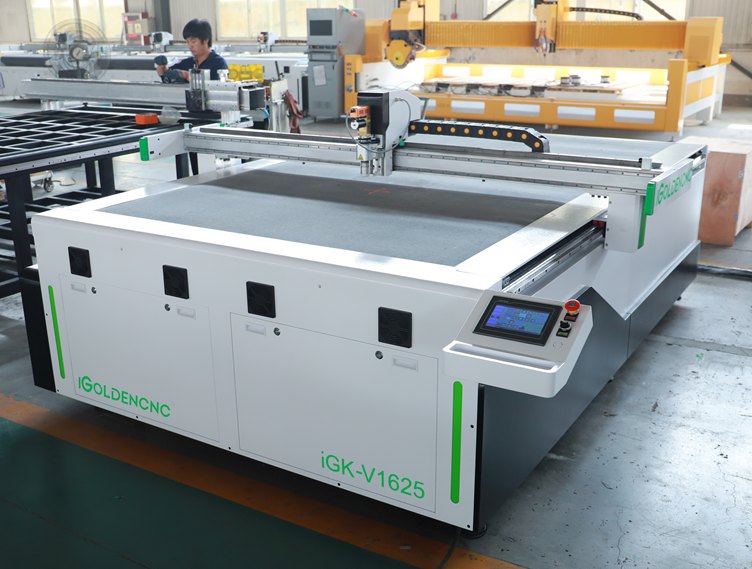
What are the main components of a CNC oscillating knife cutting machine?
A high-performance CNC Oscillating Knife Cutting Machine typically consists of the following core systems, which collectively determine cutting precision, speed, and stability.
Control System
This serves as the “brain” of the equipment, receiving processing instructions and controlling the movement of each axis. Advanced control systems enable automatic layout, path optimization, and intelligent compensation, significantly enhancing cutting efficiency and precision.
Servo Drive System
Servo motors and their drive modules execute precise displacement and speed control, ensuring smooth blade movement and responsive performance—essential for achieving high-precision cutting.
Oscillating Cutting Head Module
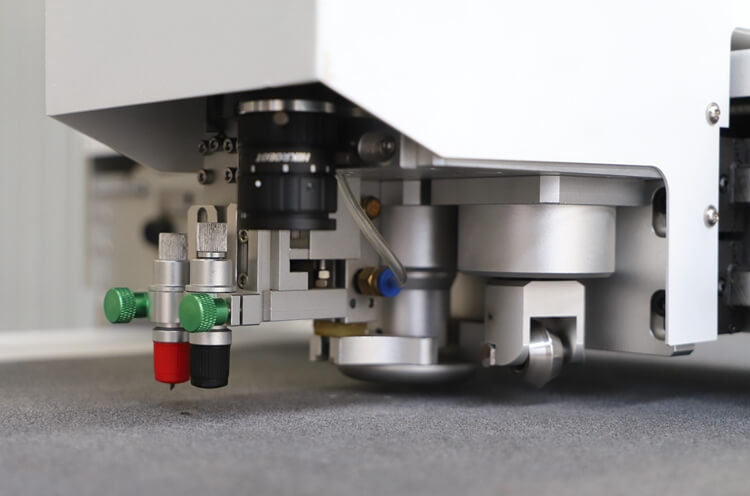
This is the machine’s “core cutting unit.” The blade head performs clean cuts on various materials through high-frequency vertical reciprocating motion. Featuring a modular design, the blade head supports tool combinations to perform multifunctional operations including cutting, creasing, punching, engraving, marking, and drawing.
Workbench and Vacuum Adhesion System
The workbench holds the material to be cut and is securely fixed by the vacuum suction system to prevent slippage during high-speed cutting. Depending on the application, options include an automatic feed table, a fixed table, or a large-format platform.
Cutting Tool Modules and Auxiliary Devices
Includes various interchangeable cutting tools (Oscillating Knifes, round knifes, pneumatic blades, etc.) and auxiliary positioning devices such as CCD cameras, laser positioning lights, and automatic tool setters.
Software System
The operating software serves as the critical human-machine interface, typically supporting import of multiple formats including DXF, AI, and PLT, with one-click generation of cutting paths. Advanced versions enable material recognition and automatic layered cutting.
Through the precise coordination of these systems, CNC Oscillating Knife cutters achieve high-efficiency, high-precision automated production for complex patterns and diverse materials.
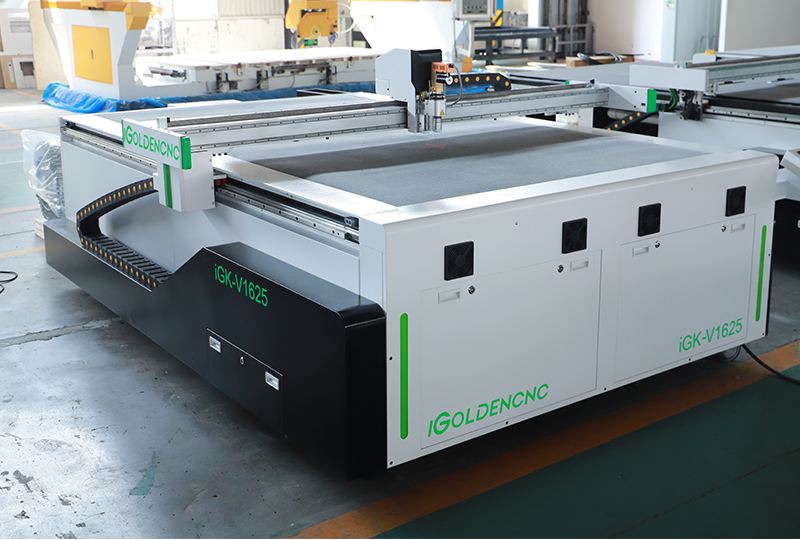
CNC Oscillating Knife Cutter Workbench Types

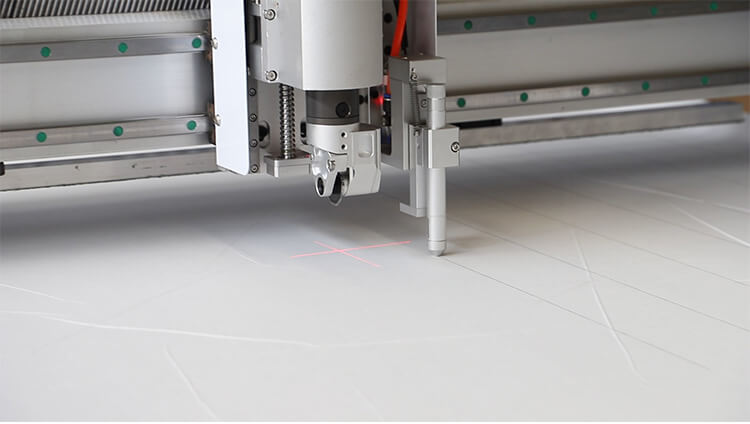
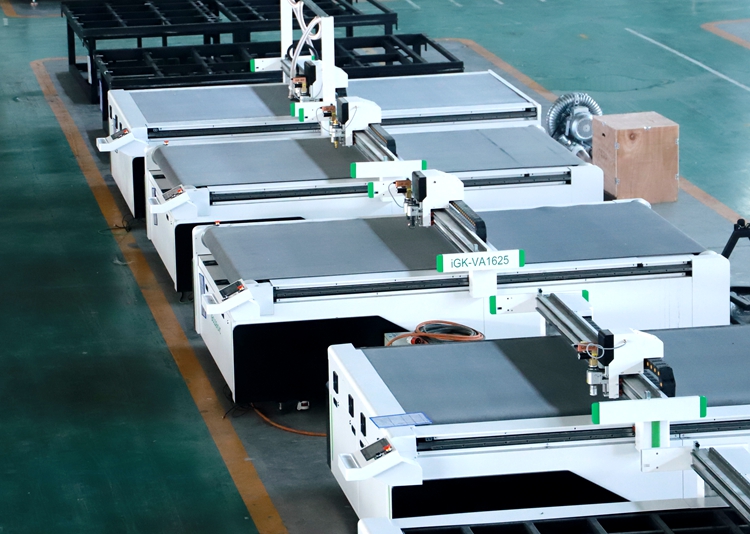
CNC Oscillating Knife cutters are primarily categorized into three types based on material feeding methods and table structures: automatic feed tables (for roll material handling), fixed tables (for standard flat processing), and large-format tables (for oversized materials).
The choice of worktable type depends primarily on three factors: your material form (roll or sheet), production volume (single-piece customization or batch production), and workshop space (sufficient loading/unloading area). For example, the textile and apparel industry extensively uses roll fabrics, making the automatic feeding worktable the optimal choice; the luggage and leather goods industry primarily processes whole hides, making the fixed worktable more suitable; while large carpets or industrial fabrics require a large-format worktable.
Automatic Feeding Workbench
Automatic feeding tables are specifically designed for roll material processing, enabling continuous automatic material conveyance. Their primary advantage eliminates manual material loading by automatically pulling rolls into the cutting zone, allowing unlimited-length cutting within fixed parameters. The entire process requires no operator intervention. For high-volume production, this automation reduces loading time by 50-70%.
Large-format workbench
The large-format workbench is specifically designed for oversized materials, accommodating dimensions up to 3000×6000mm or larger (occupying 20-35 square meters). It is primarily used in carpet cutting, large-format advertising fabric cutting, industrial composite panel cutting, marine interior material processing, automotive headliner material processing, and other applications.
Practical Tips and Recommendations:
Preferred Choice for Apparel & Textile Industry: Automatic feeding tables with automatic edge guidance automatically align pattern directions (guidance accuracy ±2mm) for printed or striped fabrics, eliminating manual alignment errors. Ideal for garment cutting requiring pattern matching.
Leather Goods Industry Priority: The fixed workbench paired with a CCD vision system or projector clearly displays leather defect areas (scars, bloodlines, etc.) and intelligently avoids them during nesting. This maximizes utilization of premium leather sections, boosting material yield from traditional 85% to 92-95% and reducing material costs by 5-10%. It is especially suitable for high-end genuine leather.
What are the application types of CNC Oscillating Knife cutters?
CNC Leather Cutting Machine
Primarily used for cutting genuine leather, artificial leather, and synthetic leather, widely applied in automotive seats, sofas, footwear, leather garments, and luggage manufacturing. Its CCD vision system and projector automatically identify leather contours and defects; it can also be paired with an intelligent nesting system to sort and grade genuine leather by section, maximizing material utilization.
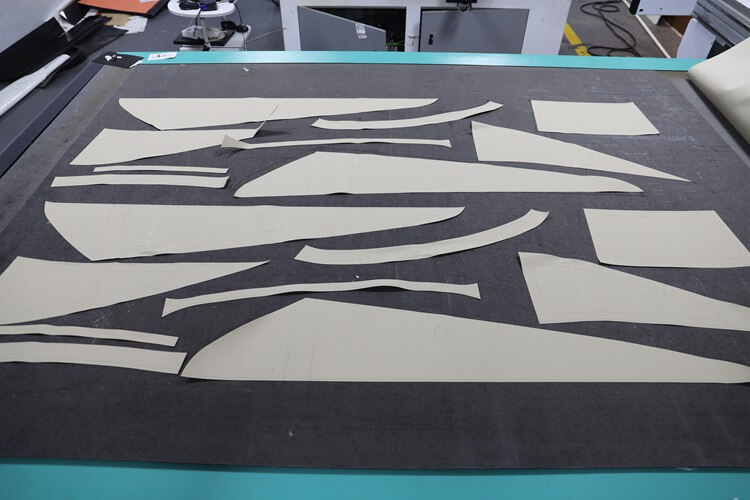
CNC Fabric Cutting Machine
Primarily used for cutting fabrics for apparel (T-shirts, shirts, pants, skirts), home textiles (sheets, duvet covers, curtains, tablecloths), luggage fabrics, and masks. Equipped with an automatic feeding system, it enables continuous, precise cutting of rolled fabrics, achieving efficiency far surpassing manual labor.
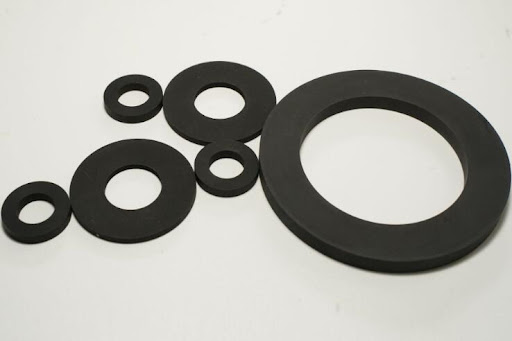
CNC Gasket Cutting Machine
Capable of high-precision cutting of various gasket materials including asbestos, rubber, and PTFE. Produces smooth edges requiring no secondary processing, ensuring optimal sealing performance. Suitable for flange gaskets, automotive gaskets, electrical insulation gaskets, and equipment maintenance gaskets.
CNC Corrugated Cardboard Cutting Machine
Capable of cutting, creasing, and slotting corrugated cardboard (single-wall, double-wall, triple-wall), honeycomb panels, and KT boards. Ideal for producing packaging box samples, small-batch custom packaging, irregular-shaped boxes, and paper display stands.
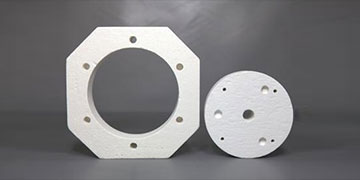
CNC Carpet Cutting Machine
Designed for cutting carpets of various materials and thicknesses, particularly suited for custom-shaped carpets. Ideal for hotel carpet customization, automotive floor mats, exhibition carpets, and industrial dust-proof carpets.
CNC Acoustic Panel Cutting Machine
Precisely cuts acoustic materials like polyester fiber soundproofing panels and rock wool boards. Performs cutting, drilling, and slotting in a single pass. Ideal for conference rooms, concert halls, theaters, cinemas, and recording studios.
CNC Composite Material Cutting Machine
Primarily used for cutting high-performance composite materials like carbon fiber, fiberglass, and aramid fiber. Applicable in advanced manufacturing sectors including aerospace, wind power, sports equipment, protective clothing, and automotive lightweighting.
CNC Advertising Cutting Machine
Primarily used for cutting and fabricating advertising materials like KT board, acrylic, PVC board, and adhesive-backed lightbox fabric. Suitable for producing illuminated letters, display stands, vehicle wraps, and signage.
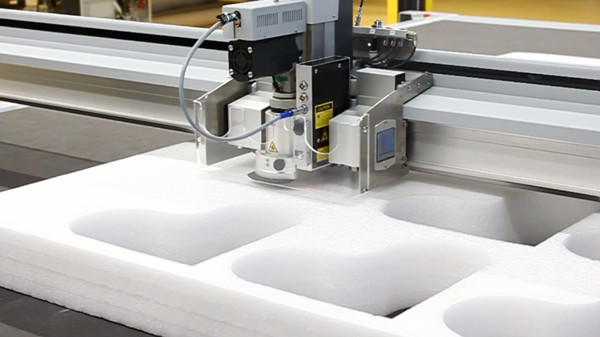
CNC Foam Cutting Machine
Primarily used for cutting and processing EPE pearl cotton, EVA foam, PU sponge, XPE cross-linked foam, etc., suitable for packaging liners.
Adaptability of CNC Oscillating Knife Cutting Machines
By combining different cutting tools, adjusting process parameters, and configuring specialized attachments, a single CNC Oscillating Knife cutter can be applied across industries, materials, and processes. This multi-functional capability makes it particularly suitable for businesses engaged in high-mix low-volume production and those requiring rapid response to market changes.
Integrated Tooling for Cutting Combination
The modular blade head design enables tool integration and combination, achieving multi-purpose functionality.
1. Leather Bag Combination (oscillating knife + punching knife): Simultaneously performs cutting and perforation tasks.
2. Packaging box combination (oscillating knife + creasing knife + punching knife): Simultaneously performs cutting, creasing, and punching, producing cardboard that can be directly folded into boxes.
3. Foam board production combination (pneumatic knife + milling knife): Simultaneously performs cutting and slotting.
4. Acoustic Panel Production Combination (high-power oscillating knife + milling knife + v-cut knife): Simultaneously performs cutting, punching, and slotting.
5. Garment Production Combination (round knife + oscillating knife + marking pen): Simultaneously performs cutting and marking.
6. Advertising Production Combination (oscillating knife + small CCD): Cuts complex patterns in a single pass.
What cutting tools can be used with CNC Oscillating Knife cutters?
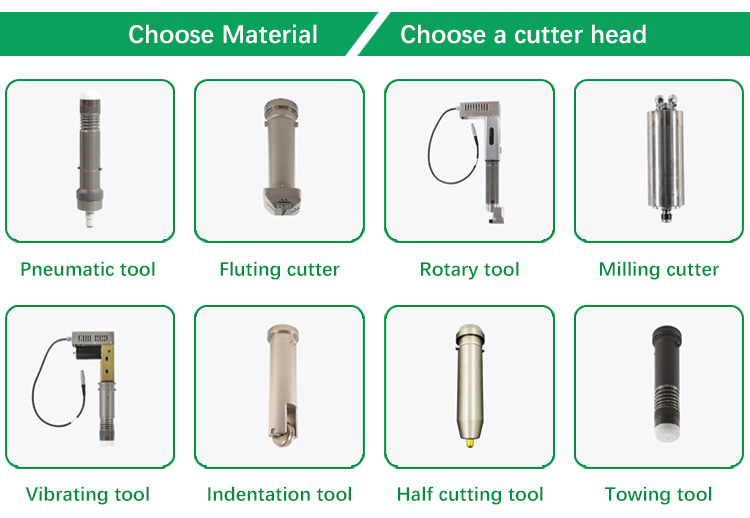
By integrating various tool modules, a single CNC Oscillating Knife cutter can perform multiple functions including cutting, engraving, creasing, punching, milling, drawing, and printing.
Fibrous materials (fabrics, felt) suit oscillating blades or round knifes; foam materials suit pneumatic blades or high-power oscillating blades; rigid materials (cardboard, plastic sheets) suit milling cutters or bevel cutters; creasing blades are used for materials requiring fold lines.
Oscillating Knife
The oscillating blade cuts soft and semi-rigid materials through high-frequency reciprocating vibration (10,000-25,000 times/minute). It is suitable for cutting single layers of thin materials under 5mm thick, such as leather, fabric, rubber sheets, felt, corrugated cardboard, etc.
Pneumatic Knife
Pneumatic cutters are specifically designed for ultra-thick, soft materials. Compressed air drives a piston to rapidly reciprocate the blade (frequency: 3,000-8,000 times/minute), featuring a large stroke (adjustable 5-15mm) and strong impact force. Compared to oscillating blades, pneumatic blades operate at lower frequencies but deliver greater amplitude and force, making them ideal for cutting materials over 10mm thick such as sponge, foam, and bubble wrap.
Round Knife
The circular blade is a rotary cutting tool featuring a circular blade (typically 40-80mm diameter) that achieves cutting through high-speed rotation (3,000-6,000 rpm). Its primary advantage lies in its rapid cutting speed, reaching 800-1,200mm/sec for straight and gentle curved cuts—2-3 times faster than oscillating blades. round knifes are particularly suited for high-speed cutting of thin, fibrous soft materials such as fabrics under 5mm thick, non-woven fabrics, and gauze.
400W High-Power Oscillating Knife
The 400W high-power oscillating blade is an enhanced version of the standard oscillating blade. Its motor power is increased from the conventional 150-200W to 400W or even 500W, delivering stronger oscillation force and deeper cutting capability.
This blade is specifically designed for processing hard materials, thick materials, or multi-layer stack cutting, such as: – Multi-layer leather stack cutting (6-10 layers, total thickness up to 15-25mm) – Thick cardboard cutting (10-15mm corrugated cardboard or honeycomb cardboard) – Hard rubber cutting (industrial rubber with Shore A hardness 70-90) – Carbon fiber composite material cutting (prepregs or cured sheets).
Selection Recommendations: For primarily thin materials (<3mm) or single-layer cutting, the standard oscillating blade suffices. For frequent handling of thick materials (>8mm), rigid materials (rubber, composites), or multi-layer stack cutting (>4 layers), the high-power oscillating blade is strongly recommended.
V-Cut knife
The bevel cutter processes various V-groove and bevel specifications by adjusting the blade installation angle (0°, 15°, 22.5°, 30°, 45°). It can process soft glass, PVC, honeycomb panels, KT boards, corrugated paper, vertical corrugated boards, gray cardboard, etc., with thicknesses <13mm.
Half-Cut knife
The half-cut blade achieves precise depth positioning by automatically adjusting the tip location, cutting only through the top layer without penetrating the bottom layer. It processes materials <2mm thick, including labels, adhesive labels, vehicle decals, reflective stickers, magnetic stickers, PP paper, PP adhesive-backed paper, rubber cloth, imitation leather, cardstock, and soft glass.
Drag knife
A trailing cutter is a non-powered, passive cutting tool that relies on material resistance to drive the blade into the material during machine movement. Suitable only for extremely thin and soft materials, it delivers smooth cuts at high speed with excellent cost-effectiveness and low maintenance. Applications include: self-adhesive labels, plastic films (0.05-0.3mm), paper (80-200g coated paper), protective films (phone screen protectors, automotive films), PP paper, PP adhesive-backed paper, reflective materials, vehicle decals, and ABS plastic.
Milling knife
A milling cutter is a rotating, hard cutting tool. Unlike the aforementioned flexible cutting tools, milling cutters are specifically designed for precision machining of hard panels such as acrylic sheets (PMMA, 1-20mm thick), rigid PVC sheets (3-15mm), medium-density fiberboard (MDF, 3-18mm), aluminum composite panels (3-6mm), and KT boards (3-10mm). Milling cutters can perform various processes including cutting, engraving, slotting, chamfering, and drilling.
Creasing knife
Creasing blades do not sever materials but instead press grooves or crease lines onto surfaces. When used in conjunction with cutting blades, they enable simultaneous “outline cutting + creasing” in a single pass. They are applied to folding paper products like paper boxes, packaging boxes, paper bags, shopping bags, and folders.
Punching knife
Punching cutters create circular or irregular holes in materials through vertical stamping actions. They offer high speed, precision, and consistent hole diameters, suitable for applications like belt perforation, shoe upper ventilation holes, folder hole punching, tag lanyard holes, and luggage rivet holes.
Marking Pen
The brush tool enables drawing patterns, markings, or text on material surfaces for product identification and traceability.
Printing Tool
Utilizing UV inkjet print heads (with UV-curable ink), it prints full-color patterns on various material surfaces, including serial numbers, QR codes, logos, and more.
What materials can the CNC Oscillating Knife cutter process?
Paper Products: Corrugated cardboard (single-wall 3-5mm, double-wall 6-9mm, triple-wall 10-15mm), cardstock (0.3-0.8mm coated paper, white cardstock), kraft paper (0.2-0.5mm), grayboard (1-3mm), honeycomb paperboard (10-20mm), etc.
Plastics and Foam Materials: EVA foam (density 30-80 kg/m³), PE bubble wrap (EPE, density 20-40 kg/m³), XPE cross-linked foam (density 30-50 kg/m³), polyurethane foam (PU foam, density 15-60 kg/m³), PVC foam board (3-20mm), KT board (foam board, 3-10mm), furong board (5-15mm), silicone sponge, nylon, etc.
Fibers and Composites: Carbon fiber cloth (prepreg or dry cloth), fiberglass cloth, aramid fiber cloth (Kevlar), fiberglass board (FR4), carbon fiber board, graphite paper, and other high-performance materials.
Fabrics and Leather: Natural leather (cowhide, sheepskin, pigskin, thickness 0.6-2.5mm), synthetic leather (PU leather, PVC leather, microfiber leather, thickness 0.5-3mm), textile fabrics (cotton cloth, synthetic fiber cloth, canvas, knitted fabric, non-woven fabric, thickness 0.1-5mm), etc.
Rubber Materials: Natural rubber, synthetic rubber (styrene-butadiene rubber, nitrile rubber), silicone rubber, neoprene rubber, EPDM rubber, etc., with thicknesses ranging from 0.5mm to 10mm.
Special Materials: Felt, reflective fabric, reflective tape, sound-absorbing cotton, insulating paper, insulating cloth, mica sheets, medical non-woven fabric, soft glass, acrylic sheets, cork boards.
In which industries can CNC Oscillating Knife cutters be applied?
Car Industry
Primarily used for processing automotive interior components, including seat covers, dashboard trim, door panel decorations, headliners, floor mats, sound-absorbing cotton, sealing strips, genuine leather steering wheel covers, etc.
Advertising & Packaging Industry
Used for advertising production (signage, illuminated letters, display stands, vehicle decals) and packaging products (packaging box samples, custom-shaped packaging, small-batch custom packaging). It meets demands for diverse product types, small batch sizes, urgent delivery, and frequent design changes.
Apparel and Bag Industry
T-shirts, shirts, suits, sportswear, workwear, formal wear, printed fabrics, silk, lace, tulle; backpacks, handbags, canvas bags, hiking packs, leather wallets.
Home Furnishings Industry
Sofa covers, seat cushions, throw pillows, curtains, tablecloths, rugs, doormats, bedding sets, wall decals.
Building and Decoration Industry
Exterior wall insulation wool, roof insulation boards, pipe insulation sleeves, wall decorative panels, ceiling panels, partition panels, door and window seals, expansion joint sealants, waterproofing membranes, acoustic panels.
Sealing Materials Industry
Industrial gaskets, sealing rings, vibration dampers, automotive engine gaskets, transmission gaskets, oil seal gaskets, transformer insulation gaskets, motor insulation boards, switchgear insulation pads.
Sports Equipment Industry
Carbon fiber bicycle frames, tennis rackets, golf clubs, snowboards, surfboards, knee pads, elbow pads, wrist guards, helmet liners, boxing glove liners, yoga mats, fitness mats, gymnastics mats, sports flooring mats.
Medical Supplies Industry
Disposable surgical gowns, medical bed sheets, surgical drapes, masks, medical foam packaging padding.
Enhanced Feature Configurations Compatible with CNC Oscillating Knife Cutting Machines
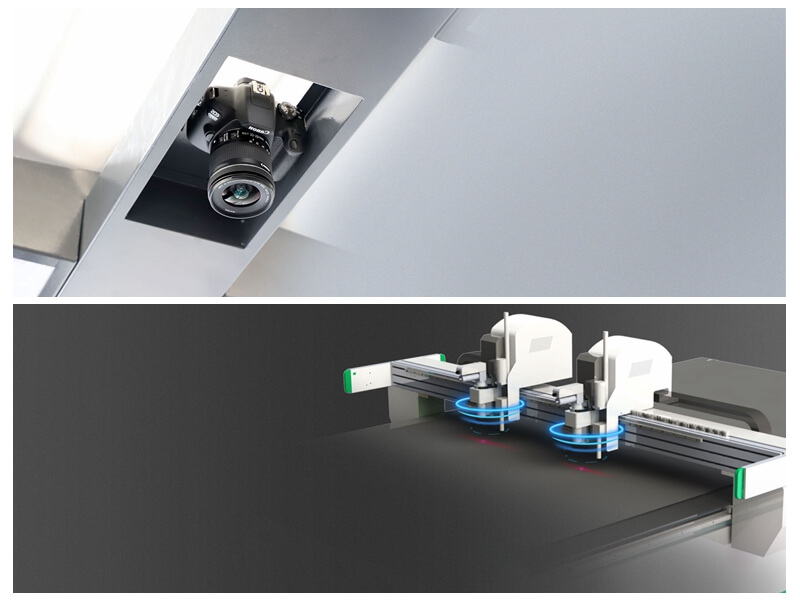
CCD Vision Positioning System
CCD vision positioning systems are available in large CCD and small CCD configurations.
Large CCD: Automatically identifies and extracts pattern contours, performs automatic contour cutting, eliminating the need to import graphics. Ideal for precise cutting of printed fabrics in the apparel industry.
Small CCD: Identifies registration marks, QR codes, and barcodes. Primarily used for advertising industry cutting, reducing downtime by completing multiple advertising pattern cuts in a single pass.
Genuine Leather Intelligent Nesting System
Suitable for cutting whole hides (cowhide, sheepskin, pigskin), it enables zone-specific grading of leather to maximize material utilization.
Projector
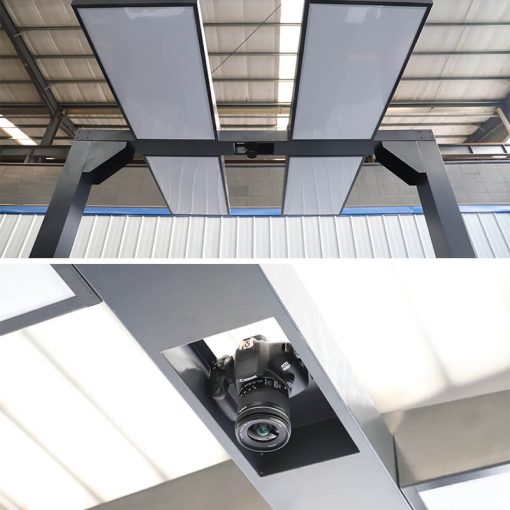
Projects cutting patterns 1:1 onto the work surface for quick alignment and layout preview, especially suitable for irregular materials like whole cowhides.
Automatic Feeding Stand System
Reduces manual loading time by over 80%, enabling continuous operation. Ideal for processing roll materials like fabrics, leather, and films. Accommodates multiple rolls for multi-layer cutting.
Auto-Alignment Stand
Ensures roll materials remain perfectly aligned during extended continuous feeding without deviation.
Automatic Knife Calibration System
Utilizes laser positioning for automatic tool calibration, minimizing deviations caused by manual adjustment and enhancing cutting precision.
Laser Positioning Light
Assists in maintaining vertical and parallel material positioning, ideal for extra-long material sheets.
Dust Extraction and Waste Collection System
Cleans dust and debris generated during cutting to maintain precision and extend equipment lifespan.
Advantages and Features of CNC Oscillating Knife Cutting Machines
1. No heat damage, preserving material properties
- Fabric Materials: No scorched edges, no yellowing, no hardening; can be sewn immediately after cutting.
- Foam materials: No heat shrinkage deformation, stable dimensional accuracy.
- Leather materials: No odor generation, soft edges without hardening.
- Composite Materials: No interlayer separation due to heat.
2. High precision to meet exacting manufacturing demands
CNC Oscillating Knife cutting machines achieve cutting precision of ±0.1mm and repeat positioning accuracy of ±0.05mm.
3. Flexible production with zero tooling investment
Zero tooling investment required; simply swap cutting tools and files to rapidly respond to customized customer demands.
4. Modular design for multi-functional operation
By configuring different tools, a single machine can perform multiple processes: cutting, punching, creasing, engraving, slotting, scribing, and marking.
5. High material utilization, reduced production costs
CNC Oscillating Knife cutters optimize material usage through intelligent nesting software.
6. Significant labor cost savings
Automated cutting reduces reliance on skilled operators, lowering labor expenses. The machine’s user-friendly operation minimizes training time, saving on labor costs.
7. Substantially increased production efficiency
CNC Oscillating Knife cutters achieve cutting speeds up to 2000mm/s with continuous operation capability. Their cutting speed is approximately 8 times faster than laser cutters.
8. Consistent and Stable Cutting Quality
Automated cutting eliminates human error, ensuring consistent product quality for each piece. This reduces rework and scrap losses, minimizing customer complaints and after-sales costs.
9. Eco-Friendly and Safe, Meeting Modern Production Standards
The cutting process produces no exhaust emissions, generates no harmful gases, and operates at low noise levels. Operators have no direct contact with cutting tools, ensuring high operational safety.
10. Rapid Market Response & Shortened Delivery Cycles
From design to production within one day, accommodating custom requirements and urgent orders.

IGOLDEN BLOG
Thank you for visiting the iGOLDENCNC website. iGOLDENCNC is the professional supplier of CNC machinery application solution, within the business of producing and selling CNC machinery and accessories.